How To Help A Teenager With ADHD Without Medication In 2026
You can help a teenager with ADHD without medication by building consistent routines, using cognitive behavioral therapy (CBT), adding daily exercise, improving sleep habits, and working with their school on formal accommodations like 504 plans. These strategies won't replace medication for every teen, but for many families, they're either the starting point or the full plan.
About 7.1 million U.S. children have received an ADHD diagnosis, according to a 2024 CDC study using 2022 National Survey of Children’s Health data. And roughly 30% of those kids aren’t getting any ADHD-specific treatment at all. If your teen falls into that gap, or if medication side effects have pushed your family toward alternatives, you’re not alone in searching for another path.
The short version: non-medication strategies for teen ADHD work best when you combine several of them and stay consistent. No single tool fixes everything. I’ve seen families try one technique, give up in a week, and declare that “nothing works.” The ones who succeed stack 3–4 strategies together, give each one at least 6–8 weeks, and adjust as they go.
This article covers what actually works (with data), what’s overhyped, and how to build a system that fits your teenager’s day. We’re not covering supplements, biofeedback, or special diets here. The Canadian Paediatric Society’s position is clear: there’s little evidence that most alternative therapies help ADHD symptoms, and some can cause side effects. So we’re sticking to what the research supports.
What Are the Best Non-Medication Strategies for Teens with ADHD?
The most effective non-medication strategies target executive functioning, the set of mental skills responsible for planning, organizing, and following through. ADHD disrupts these skills directly, so any plan that doesn’t address them is treating symptoms instead of the cause.
A 2024 PCORI systematic review confirmed that psychosocial treatments can reduce ADHD symptoms, but with smaller effect sizes than medication. That’s not a reason to skip them. It means you need to be realistic about timelines and willing to layer multiple strategies.
Why Routines and Structure Matter for ADHD Teens
ADHD brains struggle with something called time blindness. Your teen isn’t being lazy or defiant when they lose two hours and can’t explain where the time went. Their internal clock works differently, and predictable routines act like an external clock they can rely on.
Set consistent wake-up times, meal times, homework blocks, and bedtimes. Use a daily planner (paper or digital) that blocks out homework, hobbies, chores, downtime, and social time. Model your own routine out loud. “I’m going to do X, then Y, then Z” gives your teen a template for how structured thinking sounds.
Don’t expect this to click fast. Most families I’ve worked with need 4–6 weeks of gentle reminders before the routine starts running on its own. The trick is staying patient while your teen builds the habit, not doing it for them.
Do Visual Aids and Planners Actually Help?
Yes, but only if your teen picks the system. A color-coded wall calendar means nothing if they never look at it. Digital calendars with push notifications tend to work better for most teens because the reminder meets them where they already are: on their phone.
What works: to-do list apps with checkboxes (the dopamine hit from checking things off is real), whiteboard checklists in their room, and breaking big assignments into 3–5 smaller tasks with separate due dates. What doesn’t work: buying a $30 planner and expecting them to use it without coaching.
How Behavioral Therapy Techniques Work at Home
Behavioral therapy principles aren’t limited to a therapist’s office. Positive reinforcement, clear expectations, and small rewards for effort (not just results) can reshape daily behavior over time.
A simple reward chart for completed homework or chores gives teens a visible link between effort and progress. Research on ADHD reward systems shows that immediate feedback and meaningful rewards boost motivation in ADHD teens more than delayed consequences do. Focus on effort over grades. Your teenager probably hears more correction than praise during a typical day. Flipping that ratio matters more than most parents realize.
Is CBT Effective for Teens with ADHD?
CBT teaches teens to recognize negative thought patterns and build practical coping skills. For ADHD, that means hands-on training in time management, organization, and problem-solving. One open study found that 67% of patients were rated “much or very much improved” in ADHD symptom severity after combined CBT and pharmacotherapy (Rostain & Ramsay, published in Focus). Even without medication, CBT alone shows improved parent-rated ADHD symptoms in adolescents.
Contrarian take: standard CBT isn’t always a good fit for ADHD. A 2024 study in Frontiers in Psychiatry found that adults with ADHD who received non-adapted CBT frequently reported negative experiences, increased feelings of failure, and lower self-esteem. The therapy needs to be modified for ADHD-specific challenges, not run from a generic anxiety protocol. If your teen’s therapist doesn’t have ADHD-specific training, that’s a red flag.

How Much Exercise Does an ADHD Teen Need?
A 2024 meta-analysis in Frontiers in Psychology found that aerobic exercise produced above-moderate effect sizes for improving inhibitory control, cognitive flexibility, and working memory in children with ADHD. A separate 2025 network meta-analysis showed thatcognitive-aerobic exercise (think: exercises that combine thinking with movement, like martial arts or team sports with strategy) had the biggest impact on working memory, with programs lasting 6–12 weeks at 60–90 minutes per session showing the strongest results.
Even 20–30 minutes of moderate activity before homework has measurable benefits. The key is consistency, not intensity. A daily walk beats a weekend gym session. And non-competitive activities like swimming, biking, or martial arts tend to stick better for ADHD teens than team sports where downtime leads to distraction.
Can Mindfulness Help a Teenager with ADHD?
Mindfulness teaches teens to notice what’s happening internally before reacting. For ADHD, that pause between stimulus and response is the skill they’re missing. Research shows mindfulness improves self-regulation in teens with ADHD, and it’s one of the few interventions that addresses emotional dysregulation directly.
Start small. A 3-minute breathing exercise before homework is more useful than a 20-minute guided meditation they’ll never finish. Journaling, short visualization exercises, and yoga are all options. Mindfulness apps like Headspace or Calm offer ADHD-friendly sessions under 5 minutes. If your teen resists the word “mindfulness,” don’t use it. Call it “a reset” or “a brain break.”
What Sleep Habits Reduce ADHD Symptoms?
Sleep deprivation makes every ADHD symptom worse. The Canadian Paediatric Society lists poor sleep quality as a direct driver of inattention and irritability. And ADHD itself makes falling asleep harder, creating a cycle that’s tough to break.
Set the same bedtime and wake time every day, including weekends. Cut screens at least 60 minutes before bed (the blue light issue is real, but the bigger problem is stimulation keeping their brain in “go” mode). Dim the lights, try white or brown noise for focus and relaxation, and keep the bedroom cool. Small changes compound. One family I advised saw a major turnaround just by moving their teen’s phone charger out of the bedroom.
How Can Parents Support Academic Success Without Medication?
School is where ADHD symptoms show up the loudest. But your teen doesn’t have to white-knuckle it alone. The right accommodations and study systems can close the gap between what they know and what they can show on a test.

Working with Teachers and School Counselors
A 2019 study in the Journal of Attention Disorders found that roughly 20% of children with ADHD ages 4–17 don’t receive any school services to help with their condition. That’s a missed opportunity. Start by asking about 504 plans or IEPs. These aren’t about lowering the bar. They give your teen tools like extra test time, quiet testing spaces, written instructions, and assignment modifications so they can show what they actually know.
Push for specific accommodations: color-coded folders, digital calendars, verbal plus written instructions, and permission to break large assignments into checkpoints. The more concrete your requests, the more likely the school follows through.
How to Break Big Projects into Manageable Steps
A 10-page research paper looks impossible. Picking a topic, finding 3 sources, and writing one paragraph? That’s doable. The shift from one giant task to a sequence of small tasks is the single highest-impact study skill for ADHD teens.
Use checklists with visible progress tracking. Celebrate each step, not just the final product. And help your teen build these executive functioning skills by walking through the breakdown process together rather than doing it for them.
How to Set Up a Distraction-Free Study Space
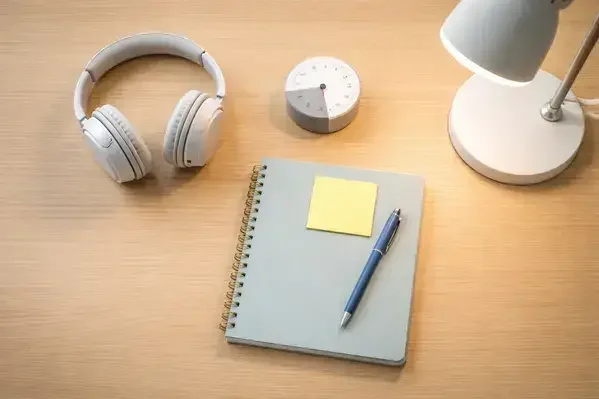
ADHD makes filtering out irrelevant stimuli genuinely difficult. A cluttered desk, phone notifications, and background TV aren’t just distractions. They’re competing signals that an ADHD brain can’t deprioritize the way a neurotypical brain can.
Set up a dedicated, tidy workspace. Noise-canceling headphones help. The Pomodoro technique (25 minutes of work, 5-minute break) matches how ADHD attention naturally cycles. Phone goes in another room, not just face-down. Experiment with lighting and seating, because some teens focus better standing, sitting on a wobble stool, or in a different room entirely. White or pink noise can also help. Studies suggest these sounds may reduce background distractions for adolescents with ADHD.
Building Confidence and Emotional Strength in ADHD Teens
ADHD takes a toll on self-esteem. By middle school, most teens with ADHD have a mental highlight reel of failures, missed deadlines, and "why can’t you just focus?" comments. Emotional support isn’t a soft add-on to their treatment plan. It’s the foundation that makes every other strategy stick.

Recognizing Strengths and Celebrating Wins
Your teen is more than their diagnosis. Maybe they’re wildly creative, funny, perceptive, or energetic in ways their peers aren’t. Point that out. Regularly.
Did they start homework without being asked? That’s a win. Did they finish a tough assignment? Acknowledge the effort, not just the grade. Research confirms that encouragement and immediate feedback boost motivation in teens with ADHD more than punishment or consequences. The families I’ve seen get the best results are the ones who make reward systems part of daily life, not just during crisis moments.

Teaching Problem-Solving and Coping Skills
Setbacks are normal. But for an ADHD teen, each one can feel like proof that they’re broken. Teaching them to break down problems, brainstorm solutions, ask for help, and treat mistakes as data (not character flaws) builds the kind of emotional resilience that carries them into adulthood.
Ask: “What worked last time?” instead of “Why didn’t you do it right?” That one question shifts the conversation from blame to problem-solving. And it teaches your teen that their past successes are repeatable, not random.
What If Non-Medication Strategies Aren’t Enough?
Helping a teenager with ADHD without medication takes time, patience, and a willingness to adjust. Some families find that stacking routines, therapy, exercise, and school accommodations is enough. Others discover that non-medication strategies work best alongside a low dose of medication, and that’s a valid choice too.
The goal isn’t to avoid medication at all costs. It’s to give your teen a toolbox of skills they’ll carry for life, whether they take medication or not. If you’ve tried layering 3–4 strategies consistently for 2–3 months and your teen is still struggling in school, friendships, or emotional regulation, talk to a specialist. An executive function coach or ADHD-trained therapist can assess what’s working, what’s not, and where to go next. Families who partner with a team that understands this space tend to find the right combination faster than those going it alone.
FAQs
Can ADHD be managed without medication in teenagers?
Yes. Strategies like cognitive behavioral therapy, daily exercise, structured routines, and school accommodations can reduce ADHD symptoms in teens. A 2024 CDC study found that about 44% of children with current ADHD received behavioral treatment, and roughly 16% used only behavioral treatment without any medication. The effectiveness depends on symptom severity and how consistently the strategies are applied.
What is the most effective non-medication treatment for ADHD?
Cognitive behavioral therapy (CBT) adapted for ADHD is considered the most effective non-medication option. One study found 67% of patients showed significant symptom improvement after combined CBT and pharmacotherapy. For teens not using medication, CBT still shows measurable improvements in parent-rated symptom scores, time management, and organizational skills.
How does exercise help teenagers with ADHD?
Exercise increases dopamine and norepinephrine in the brain, the same neurotransmitters ADHD medications target. A 2024 meta-analysis found that aerobic exercise produced above-moderate effect sizes for inhibitory control and working memory in children with ADHD. Even 20 to 30 minutes of moderate activity before studying can improve focus and reduce impulsivity.
What school accommodations can help a teenager with ADHD?
Common accommodations include extra time on tests, quiet testing spaces, written plus verbal instructions, and breaking large assignments into smaller checkpoints. These are typically formalized through a 504 plan or an IEP. A 2019 study found that about 20% of children with ADHD receive no school services at all, making it worth pushing for formal accommodations.
Does mindfulness work for teens with ADHD?
Research shows mindfulness can improve self-regulation and emotional control in teens with ADHD. It’s most effective when started small, such as a 3-minute breathing exercise before homework, and built up gradually. Mindfulness addresses the emotional dysregulation side of ADHD that other strategies often miss.
How much sleep does a teenager with ADHD need?
Teenagers generally need 8 to 10 hours of sleep per night, and ADHD makes both falling asleep and staying asleep harder. Poor sleep worsens inattention, irritability, and emotional reactivity. Setting the same bedtime and wake time every day (including weekends), cutting screens 60 minutes before bed, and using white noise can make a measurable difference.
When should parents consider medication if non-medication strategies aren’t working?
If your teen has consistently used 3 to 4 non-medication strategies for 2 to 3 months and still struggles with school performance, friendships, or emotional regulation, it’s worth consulting a specialist. About 53.6% of children with current ADHD take medication according to 2022 survey data, and combining medication with behavioral strategies typically produces the strongest outcomes.