Parenting A Teen With ADHD In 2026: What Actually Helps
Parenting a teen with ADHD means juggling mood swings, missed homework, and social blowups while your kid is also pulling away from you. Roughly 6.5 million U.S. children carry an ADHD diagnosis right now, per 2024 CDC data. And the teen years are where the wheels tend to come off, because schools expect more independence at the exact moment ADHD makes independence harder.
Parenting a teen with ADHD requires a specific combination of structure, patience, and behavioral strategies. Clinical guidelines from the AAP recommend parent training alongside medication for adolescents, and teens who receive both show better long-term outcomes in executive function, academics, and emotional regulation than those on medication alone.
I’ve worked with families where the teen was bright, motivated on paper, and still failing three classes. The issue wasn’t effort. It was a gap between what the brain could plan and what the brain could execute. That’s what this article is about: closing that gap with strategies that hold up in real households, not just in textbooks.
What Can Parents of Teens With ADHD Do Differently?
Start by learning what you’re actually dealing with. ADHD isn’t a focus problem. It’s a self-regulation problem that shows up in focus, impulse control, emotional responses, and time awareness. When parents understand that distinction, they stop taking the behavior personally.
A 2024 study published in the Journal of Clinical Child & Adolescent Psychology found that about 60% of children with behavioral or mental health conditions receive some form of behavioral treatment. That sounds decent until you realize 40% are getting nothing beyond medication, or nothing at all. Your teen doesn’t outgrow the need for support. The support just needs to change shape.
Remind yourself regularly: your teenager isn’t being difficult on purpose. Their brain is wired to prioritize the interesting over the important. That’s neurology, not defiance.
How ADHD Shows Up Differently in Every Teenager
ADHD doesn’t look the same in any two kids. What trips up your teen might not match what you’ve read online. Think about which problems are loudest in your house and target those first.
Teens who are mostly hyperactive may need physical outlets and permission to move. The impulsive ones need scripts for pausing before they act or speak. And the inattentive teens (the ones who seem like they’re listening but aren’t absorbing a word) usually need help building systems for planning, organizing, and managing time blindness.
Most teens have a mix. Pick the one area causing the most friction, and start there. Trying to fix everything at once guarantees you fix nothing.
How Do You Talk to a Teen About Their ADHD?
Directly, and without shame. Teens can smell a lecture from three rooms away, so skip the speech and have a conversation instead.
Tell your teen that ADHD isn’t a character flaw. It’s a brain difference that makes certain things harder. Then be honest about what you need from them. Not "try harder" (useless) but something specific, like "let’s figure out a system so your backpack isn’t a black hole."
Set one goal at a time. One. Families who try to overhaul everything at once tend to burn out within weeks. Research from the APSARD 2026 conference showed that adolescent treatment outcomes suffer most when parent involvement drops off. Keep it small, keep it consistent, and build from there.

Hands-On Help Beats Nagging Every Time
Your teen’s room is a disaster. Yelling "clean it up" won’t teach them how to clean it up. If your teenager lacks organization skills because of ADHD, you need to get in there and build systems together. Sort things side by side. Label shelves. Make it stupidly easy to put stuff where it belongs.
Will it get messy again? Absolutely. That’s not failure. That’s the process. Skills take repetition, and ADHD brains need more reps than average.
The same principle applies to social skills. About half of teens with ADHD have serious peer relationship problems, according to the Child Mind Institute. They interrupt, talk over friends, or miss social cues entirely. Don’t blame your teen for it. Name it ("ADHD makes waiting to talk really hard"), give them a phrase to practice ("listen longer"), and look into executive function coaching for teens if the skill gaps are wide.
Does ADHD Treatment Need to Change in the Teen Years?
Yes. Always. If your teen was diagnosed at seven, their needs at fifteen are completely different.
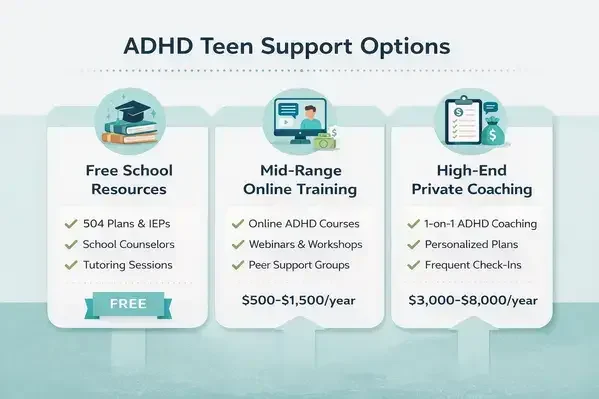
ADHD treatment typically includes medication, behavioral therapy, parent training, and school accommodations. The AAP’s clinical guidelines recommend all four for adolescents, not just pills. A 2025 review of intervention costs found that behavioral programs run roughly $178–$211 per participant, far less than most families assume. Ask your teen’s therapist about parent management training (PMT). It’s one of the most evidence-backed tools available, and most parents have never heard of it. Groups like CHADD offer parent training programs starting at $199.
If your child has an IEP, update it for high school. The accommodations that worked in fifth grade won’t cover what’s needed in tenth. Extra test time, quieter workspaces, and support from an academic coach can make the difference between a teen who scrapes by and one who actually learns the material.
Here’s a contrarian take: medication alone is one of the most expensive mistakes families make. Not because meds don’t help (they often do), but because medication without behavioral strategies is like buying a gym membership and never going. You’re paying for a tool you’re only half-using.

Your Relationship Matters More Than Your Rules
Teens with ADHD get criticized constantly. By teachers, by peers, by themselves. If you pile on at home, you don’t get better behavior. You get a teenager who shuts down or lashes out.
Focus on what your teen does well, even when the list feels short. Specific praise ("you remembered to text me when you got there, thank you") does more than generic encouragement. Rewards-based approaches consistently outperform punishment for ADHD kids of all ages.
Spend time together doing things your teen actually enjoys. Not everything has to be a teaching moment. Sometimes the most productive thing you can do is just be around, laughing about something dumb, so your kid remembers you’re on their team.
Scolding, blaming, and lecturing increase the behaviors you’re trying to reduce. I know that’s frustrating to hear. But the data is clear, and I’ve watched it play out with dozens of families.
Helping Teens With ADHD Discover Their Strengths
Teens with ADHD hear what they can’t do all day long. They can’t sit still, can’t pay attention, can’t finish things. Over time, that turns into "I can’t do anything right."
But ADHD brains come with real advantages. Quick thinking, adaptability, creativity, and the ability to hyperfocus on things they care about. Your job is to help your teen identify those strengths and use them. A teen who struggles with essays but can build an engine from scratch isn’t broken. They just need a path that fits. Working with an experienced coaching team or a school counselor to map strengths to real-world goals can shift a teen’s entire self-image.
When your teenager knows you see their strengths (not just their ADHD), it changes the relationship. It changes their confidence. And in my experience, it changes their willingness to work on the hard stuff.
FAQs
Is ADHD coaching worth it for a teenager?
It depends on the provider. Behavioral parent training combined with teen coaching outperforms medication alone for building executive function skills, per AAP guidelines. But coaching is unregulated, so always verify credentials (look for ICF certification plus ADHD-specific training) and set clear 8-week progress benchmarks before committing.
How much does parent training for ADHD teens cost?
Individual coaching sessions typically run $75–$200 per session out of pocket. CHADD’s parent-to-parent program costs $199 as a one-time bundle. Insurance sometimes covers behavioral therapy but rarely covers pure coaching. A typical 8–12 week program totals $600–$2,400 depending on format and location.
What questions should I ask before hiring an ADHD coach?
Ask about their specific ADHD coaching certification, their experience working with teens your child’s age, what outcome metrics they track, and what the plan is if progress stalls after eight weeks. If they can’t answer those four questions clearly, keep looking.
Can apps replace parent training for teens with ADHD?
No. ADHD educational and cognitive training apps are growing fast (the market is projected to reach $4.4 billion by 2034), but practicing coaches report that teens rarely stick with apps beyond three months without human accountability. Apps work best as a supplement to coaching, not a replacement.
Why did my teen’s ADHD seem to get worse in high school?
High school reduces structure and increases expectations at the same time. Teens with ADHD lose the scaffolding they relied on in middle school (closer teacher oversight, simpler schedules) right when demands spike. It’s not that ADHD worsened. The gap between the brain’s capacity and the environment’s demands widened.
What is the difference between parent training and therapy for ADHD teens?
Parent training teaches you specific behavior management skills you can use at home. It targets the environment around the teen. Traditional talk therapy focuses on the teen’s internal experience. AAP guidelines rank parent training as a stronger evidence-based option for core ADHD symptoms in adolescents.
How do I keep my relationship with my ADHD teen positive?
Focus on specific praise over general encouragement. Spend time doing things your teen enjoys without turning it into a lesson. Avoid lecturing, which research shows increases unwanted behaviors rather than reducing them. Parenting a teen with ADHD effectively means being their ally first and their manager second.