Emotion Regulation In Teens With ADHD: A 2026 Parent Guide
Emotion regulation in teens with ADHD is one of the most overlooked parts of the diagnosis. If your teenager blows up over a minor comment, shuts down during homework, or swings from giddy to furious in minutes, that's not a personality flaw. It's a neurological pattern tied directly to how ADHD affects impulse control and emotional processing.
Emotion regulation refers to a person's ability to manage and respond to emotional experiences without causing harm or social problems. For teens with ADHD, that ability is impaired, and it affects both negative emotions like anger and frustration and positive ones like excitement and enthusiasm.
Most articles treat emotional dysregulation as a secondary symptom, something that tags along behind inattention and hyperactivity. The research doesn't support that. Faraone and colleagues laid out the case in a 2019 practitioner review in the Journal of Child Psychology and Psychiatry, and Hirsch and colleagues found the same pattern in adults in PLOS One in 2023. Emotion dysregulation behaves like a core feature of ADHD, not a side effect. That distinction changes how you treat it.
I'm skipping medication here. That's a conversation with your prescriber. What follows: the emotion regulation problems ADHD creates in teenagers, 4 strategies you can start this week, and the interventions with evidence behind them.

Why Teens with ADHD Struggle More with Emotions
Teens with ADHD react faster, feel harder, and recover slower than their peers. That's the short answer.
Adolescence is already volatile. Add ADHD and you get intense displays of both negative and positive emotion, stronger reactions to frustration, and mood shifts fast enough to confuse everyone in the room. Russell Barkley, one of the most cited ADHD researchers, describes these adolescents as having low frustration tolerance, impatience, and quickness to anger.
The difficulty isn't limited to bad feelings. Teens with ADHD often show over-the-top excitement too. They yell at good news, crowd into personal space, jump around in ways that read as young for their age. Classmates call it immaturity, and it turns into a social problem fast.
Then there's what it predicts. Tharaud and Nikolas tracked 4,460 youth in the ABCD study and reported the result in October 2025: ADHD symptoms at ages 9 to 12 predicted depression at 13 to 14, and 2 habits carried the link. Catastrophizing, and getting distracted instead of dealing with the feeling. Not weak regulation in general. Those 2.
EPA tracking data puts ADHD diagnosis at 13.6% of US children ages 5 to 17 in 2024, more than double the 6.3% recorded in 1997, and at 14.1% for children below the poverty level against 12.0% for those at or above it. In the 2022 National Survey of Children's Health, 77.9% of children aged 3 to 17 with current ADHD had at least one co-occurring condition. Anxiety, depression, and oppositional defiance top that list, and each makes the emotional side harder.
The daily version: bigger reactions to small frustrations, fast mood swings, more conflict with parents, friends, and teachers. Repeat it enough and you get peer rejection, family arguments, and in serious cases substance use or aggression. If you're seeing ADHD meltdown symptoms daily, emotion regulation is where the real work sits.
4 Parent Strategies That Improve Emotion Regulation in Teens with ADHD
Parents shape how teenagers experience and manage emotion. Researchers call it emotion socialization: the ways you model, discuss, and respond to feelings. When parents handle their own frustration well and answer outbursts with validation instead of punishment, outcomes improve across the board: less anxiety, less aggression, better social behavior.
The reverse holds. Meet anger with anger, minimize the feeling, or shut the conversation down, and regulation gets harder. 4 strategies the evidence supports:
Build a Coping Skills Toolkit Together
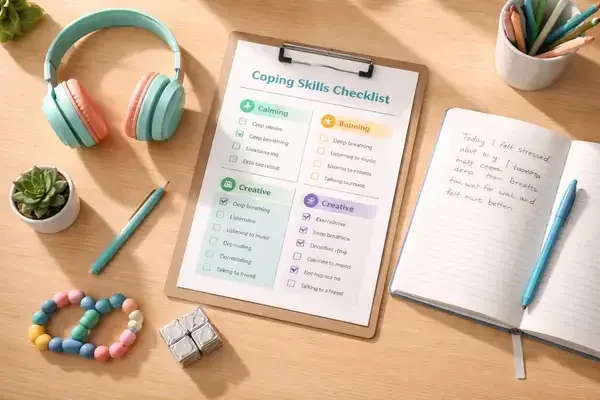
A coping skill is any behavior that helps someone feel better without causing harm. The word that matters is toolkit. No single strategy works everywhere. Your teen needs options for home, school, and public.
The ones that tend to land with teens who have ADHD: talking to someone they trust, a walk, music, drawing, journaling, deep breathing, or 10 minutes alone in their room. There's a longer age-sorted list in this breakdown of calming techniques for children with ADHD that carries over to younger teens.
Something parents miss constantly. When your teen walks out of an argument to cool off, that's regulation working. It looks like disrespect. It isn't. If your teenager asks for space mid-fight, give it, then praise it after. That's the behavior you want more of.
How Should You Respond When Your Teen Gets Upset?
Most parents default to fix-it mode ("here's what you should do") or minimize mode ("it's not that big a deal"). Both backfire with ADHD teens.
Listening without an agenda works better. You don't have to agree with the emotion, or even understand it. You have to acknowledge it exists. Try "I can tell this is frustrating. I'd be upset too if a friend said that to me." Learning ADHD triggers and how to cope helps you see these moments coming.
Telling someone their feeling is wrong doesn't remove the feeling. It stacks shame on top of it. Direct questions read as pressure too. Sitting nearby and saying nothing often does more than a lecture.

Do Healthy Habits Actually Improve Emotional Control?
Yes, and it's the least controversial claim here.
Sleep: 8 to 10 hours a night, waking within an hour of the same time daily, weekends included. No caffeine 4 to 6 hours before bed. No screens for the last 30 minutes.
Food: 3 meals plus snacks, and 8 glasses of water. Hunger tanks emotional control faster than almost anything else, and the hangry effect runs stronger in ADHD.
Exercise: 60 minutes of movement a day. It burns off restless energy and lowers anxiety, and both feed blowups. None of this fixes dysregulation on its own. It raises the floor, so the bad days are less bad.
Your Own Stress Matters More Than You Think
Running on empty means meeting your teen's outbursts with frustration instead of patience. That's not a character judgment. It's biology.
Parents of teens with ADHD carry high stress themselves, and plenty have their own regulation difficulties, since ADHD runs in families. Use your own coping skills. Protect time daily. Lean on people. A parent who models a calm response teaches more than any worksheet or app. The strategies for helping a teen with ADHD manage behavior apply to you as much as to your kid.

What Professional Interventions Work for ADHD Emotion Regulation in 2026?
Some teens need more than home strategies. The options have improved in the last 2 years.
Start with RELAX (Regulating Emotions Like An eXpert), developed by Rosanna Breaux and Joshua Langberg. It's an 8-week group program. Parents and teens meet separately for the first 60 minutes to work on coping, communication, and conflict management, then together for the last 30 minutes to practice at home. What makes it different: parents learn each skill a week before their teens, so they can model it first. That mirrors how emotion socialization works in a house.
CBT and executive function coaching have both built evidence for ADHD-related emotional dysregulation in teens and adults. Don't put too much weight on any single study, though. A 2025 multiple-baseline single-case experiment from Stockholm University and Uppsala University ran emotion regulation training with 7 girls aged 13 to 17 who had ADHD. 6 of the 7 reported better emotion management. Several also improved during the baseline period, before treatment started, which limits what you can conclude. Small, honest, promising, not proof.
The digital side is growing fast. Future Market Insights projects the ADHD digital therapy market at $2.47 billion by 2036, up from $472 million in 2026. That's vendor market research, not peer review, so read it as a signal about where money is going rather than what works. I've watched parents spend thousands on apps and unvetted coaches and get nothing back.
The vetting problem is measurable. In a coach survey reported by Katherine Ellison in March 2026, 89% of ADHD coaches had no professional mental health background, and only 63% had completed training endorsed by the ADHD Coaches Organization. Ask any coach 3 things: what their training is, what experience they have with ADHD emotional dysregulation, and how they'll show you progress.
Where Executive Function Coaching Fits
Coaching and therapy get treated as interchangeable, and that mix-up costs families money.
Therapy works on the emotion itself: where it comes from, what it means, how to sit with it. Coaching works on the system around the emotion, so fewer blowups get triggered at all. A teen who melts down every Sunday night because 4 assignments are due Monday doesn't have a feelings problem on Sunday. He has a planning problem that turned into one.
At The Ladder Method, emotional regulation is one of the 6 executive function skills we coach directly, next to organization, time management, task initiation, working memory, and cognitive flexibility. The work there is reflection and mindfulness practice that lowers overwhelm before it becomes an outburst. With teens it almost always runs alongside time-blocking and micro-goals, because the overwhelm sits downstream of a schedule nobody built.
The structure is a consultation to set goals, a coach matched to the teen's personality rather than whoever has an open slot, then weekly or biweekly sessions with check-ins that include the parents. Graduation isn't a session count. It's the point where the teen runs the system without being reminded.
Emotion regulation in teens with ADHD responds to structure, not willpower. If it's driving daily conflict, school problems, or risky behavior in your house, don't wait it out. Working with a team that understands ADHD-specific challenges is the difference between slow improvement and going in circles.
FAQs
Is emotional dysregulation a core symptom of ADHD in teenagers?
Yes. Research published in 2025 in the Journal of the American Academy of Child & Adolescent Psychiatry identifies emotional dysregulation as a core characteristic of ADHD, not just a secondary symptom. A network analysis of youth data also found that poor emotion regulation links ADHD directly to higher rates of depression.
What are the best coping skills for teens with ADHD?
Effective coping skills for teens with ADHD include talking to a trusted person, physical exercise, listening to music, journaling, deep breathing, and taking a brief break in a quiet space. The specific skill matters less than having multiple options ready for different settings (home, school, public). Teens should help choose their own strategies, since buy-in increases follow-through.
How long does emotion regulation training take to show results for ADHD teens?
A 2025 single-case experimental study from Stockholm University found positive effects on emotional clarity within weeks of consistent sessions. Group interventions like RELAX run for eight weeks. Most professionals recommend three to twelve months of structured support for lasting change, though some improvement can appear early.
Can you improve ADHD emotion regulation without medication?
Yes. Behavioral strategies, parent coaching, cognitive behavioral therapy (CBT), dialectical behavior therapy (DBT), and structured programs like RELAX all target emotion regulation directly without medication. Healthy habits (consistent sleep, regular exercise, and proper nutrition) also improve emotional control. Many families use a combination of medication and behavioral interventions.
Why does generic mindfulness often fail for teens with ADHD?
Standard mindfulness instruction assumes a level of impulse control and sustained attention that teens with ADHD don't have. A 2025-2026 research review found that ADHD is linked to lower use of adaptive emotional strategies. Mindfulness needs to be adapted for ADHD specifically, with shorter sessions, movement-based components, and acceptance-focused techniques rather than pure attention training.
How much does professional emotion regulation coaching cost for ADHD teens?
Professional coaching or therapy sessions typically run $75 to $200 per session, with full programs (20 to 40 sessions) costing $2,000 to $8,000. Budget options include digital therapy apps at $10 to $50 per month. The ADHD coaching field is currently unregulated, so parents should verify credentials and ask how progress is measured before committing.
What is the RELAX program for ADHD emotion regulation?
RELAX (Regulating Emotions Like An eXpert) is an eight-week group-based intervention for teens with ADHD and their parents. Parents and teens meet separately for sixty minutes of skill-building, then together for thirty minutes of practice. Parents learn each skill one week before their teens, allowing them to model the behavior first. The program targets coping, communication, and conflict management.