Executive function coaching for household logistics helps adults build systems for the planning side of home life. That covers bills, meals, appointments, school forms and the family calendar. The coaching targets the planning behind the chores, since most adults already know how to do the chores themselves.
About 6% of US adults, roughly 15.5 million people, reported a current ADHD diagnosis in a late 2023 national survey from the CDC. More than half of them, 55.9%, were diagnosed at 18 or older.
This article covers the systems you run as the adult in the house. It leaves out coaching for children and anything about medication, which belongs with a prescriber.

What Is Executive Function Coaching for Household Logistics?
Executive function coaching for household logistics is one-on-one help with the planning work of running a home. You and a coach pick the step that keeps failing, such as paying bills or returning school forms, then build and test a fix over weekly or biweekly sessions. Diagnosis and treatment stay with clinicians.
Executive function means the mental skills that run your other skills. They hold a plan in mind, get a task started and adjust when the plan changes. Home asks for all of them at once, and nobody checks your work.
About 70% of The Ladder Method's clients are neurodivergent, including people with ADHD or autism.
3 Beliefs That Make Home Feel Like a Personal Failing
It's easy to read trouble at home as a character flaw. These 3 beliefs keep that reading in place, and none of them holds up.
The first belief says that anyone who manages a team at work should be able to manage a house. Strong work performance and a slipping household can show up in the same person. The gap comes down to outside structure, which work supplies and home doesn't.
The second belief is that the right app will fix it. An app is a generic tool, and generic is the problem. The Ladder Method's adult coaching page says it directly. "We don't provide generic productivity tips you could find online." The coaching designs systems around the specific barriers you run into instead.
Then there's the idea that needing help means you're lazy. Laziness means avoiding effort. You can work hard all weekend on laundry, dishes and errands and still miss a form that was due, because effort and planning are different jobs.
Where Does Running a Household Usually Go Wrong?
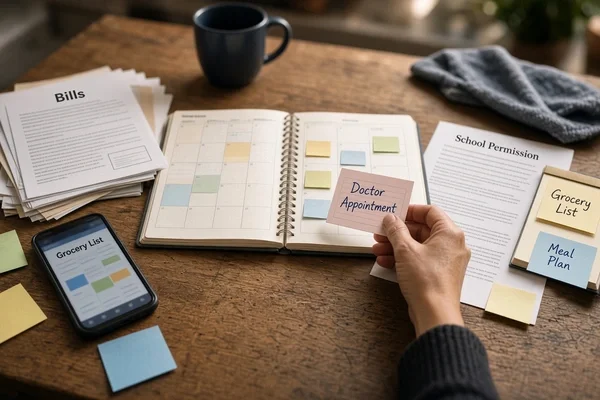
Household logistics usually break between steps. A task gets noticed, then has to be decided, then has to be done, and it can stall at any of those points.
The Mental Load Nobody Sees
Sociologist Allison Daminger interviewed 70 people from 35 couples for a 2019 paper in the American Sociological Review. She split the thinking side of housework into 4 stages. You anticipate a need, look at the options, decide, then check that it happened. The women she talked to carried more of the anticipating and checking, while decisions were shared about evenly.
A 2019 Arizona State University study of 393 mothers found the same tilt. Nearly 9 in 10 said they alone organized the family schedule.
Chore charts have a blind spot here. A chart splits the doing, but the mental load of noticing and checking can stay with whoever made the chart. Handing over a whole area, like school forms or car upkeep, including the job of remembering it, moves more of the load.
For adults with ADHD or other forms of executive dysfunction, anticipating is the stage that leans hardest on working memory. Nothing outside you announces that a passport is about to expire. Women with ADHD are also more likely to be missed or misdiagnosed, so the gap can get labeled a personality flaw for years.
Dinner, Bills, the Dentist and School Forms
Each of these fails at a different step, and the step tells you which skill to work on.
Dinner fails at the deciding step. The groceries are in the fridge, but nobody has picked a meal, and by the time everyone's hungry, the energy to choose is gone.
Appointments slip before they're ever written down. A reminder text arrives at a bad moment, gets read, and never reaches the calendar.
School paperwork fails because it arrives in bursts. Signups, consent forms and account notices can land in the same week, each one needing action at a moment when you're busy with something else. Private school admissions add test prep to the pile, and our ISEE vocabulary flashcards put 250 commonly tested words in a single box.
Bills fail at the doing step. A water bill can go late for a boring reason, like a login you can't find or a paper statement buried under the mail. Automatic payments take that step away, and our guide to living independently with ADHD covers how to set them up.
Why Running a Home Is Harder Than a Full-Time Job
Home is harder because it runs without outside structure. At work, a manager sets deadlines and the day has an end.
The hours add up, too. Full-time workers average 8.1 hours on the days they work, according to the 2025 American Time Use Survey. On an average day, 87% of women and 75% of men do some household work, and those who do spend 2.8 and 2.1 hours on it. That's a second shift with no boss and no calendar invites.
You could argue home is harder because there's more to do. That's only part of it, since long lists don't sink people by themselves. The bigger problem is that home gives no outside signal. Nobody sets a due date for the furnace filter, and the evening has no quitting time.
If time seems to vanish once you get home, time blindness may be part of it, and it has its own fixes.

What Does Household Coaching Look Like Week to Week?
A coach builds a small set of systems around the exact places your home breaks, then tests them with you until they run without the coach.
At The Ladder Method, which Candice Lapin founded in Los Angeles in 2008, the process has 5 parts.
A free consultation to understand your goals, learning style and daily challenges.
A proprietary curriculum developed by Candice Lapin.
Coach matching, which the company calls one of the most important parts of its process.
Team-based supervision and support, with administrators who regularly review the coaches' work.
Measurable progress tracking.
Adult sessions run weekly or biweekly. Each one reviews your progress since the last session and works through whatever got in the way, using real situations from your work and personal life. Coaches hold regular progress check-ins, and clients graduate once they show consistent independence with their systems. The Ladder Method reports that most clients notice measurable improvements within 4 to 8 weeks of consistent coaching.
Every coach trains in The Ladder Method framework, and the team includes coaches with master's degrees or teaching credentials in education, psychology or learning science.
The Skills a Coach Builds for Home
The Ladder Method's curriculum includes time management, task prioritization, organization and planning, memory retention techniques, self-motivation and focus, and goal setting with accountability. At home, each one lines up with a failure point above.
Organization and planning handles the capture step, so forms, reminders and appointments land in 1 place you check.
For the anticipating stage, memory retention techniques help you see a renewal coming before it's late.
Task prioritization is the fix at the deciding step, when everything at home seems urgent at once.
Home doesn't give the evening an end, so time management supplies one.
Starting the task you've been putting off draws on self-motivation and focus.
Goal setting and accountability cover follow-through, since a coach checks whether the bill got paid.
Room setup matters too, and an ADHD-friendly home makes each of these skills easier to use.
How Strong Is the 2026 Evidence for Coaching?
Coaching research is promising and still early. The 2026 studies below show gains, though none is a randomized trial.
The 2026 JAMA Network Open survey also looked at training. Of the 481 coaches, 85% lacked a professional license and 90.5% worked without supervision from a licensed clinician. Recruitment ran through ADHD groups and professional email lists, so the sample isn't random. The authors want randomized trials before anyone calls coaching safe and proven.
Outcome data is starting to come in. In a 2026 study in the American Journal of Lifestyle Medicine, adults who finished a 12-session coaching program improved on daily impairment, executive function and ADHD symptoms. Ahmann and colleagues reported medium to large effects. A follow-up of 42 adults found the gains held 6 weeks after coaching ended. The original study didn't include a control group, so time or expectations could explain some of the change.
Therapy still has the deeper evidence base. Knouse and colleagues pooled 32 studies of CBT in adults with ADHD for a 2017 meta-analysis. Against control groups, CBT improved self-reported symptoms with an effect size of 0.65 and daily functioning at 0.51. Those are moderate effects, and they're the bar coaching research has to clear.
Brain-training apps are a weak bet for this. A 2016 review of 87 publications in Perspectives on Psychological Science found working memory training raised scores on similar memory tasks but produced no convincing gains in reading, math or reasoning. That's a poor use of your evenings.

Do You Need a Coach, a Therapist or an Evaluation First?
Pick coaching if you can already name what's behind the chaos at home, like diagnosed ADHD, and you mainly need systems. Pick an evaluation or a therapist first if you can't name it yet, or if your mood or sleep has changed.
Coaching builds skills and systems. Most coaches aren't licensed, and insurance coverage is uncommon.
Therapy treats conditions like depression, anxiety and trauma. A licensed clinician provides it, and health insurance may cover it.
An evaluation tests whether ADHD, autism or something else explains the pattern. A psychologist or other qualified clinician does the testing.
Our post on coaching versus therapy goes further. You can also do both at the same time.
Signs Coaching Should Wait
You've had this problem since grade school, and it shows up at work too. The 6-question ASRS screener from the World Health Organization is a sensible first look, though only a clinician can diagnose.
Crowds, noise or changes in routine wear you out more than they seem to wear out others. A 2018 meta-analysis in Molecular Psychiatry found executive function differences across autism studies, so a good evaluation looks at ADHD and autism together.
You used to keep up and now you don't. A change like that calls for a doctor's visit before a coach, since sleep problems, depression and other health issues can all cause it.
Low mood has hung around for weeks. A 2014 meta-analysis in Psychological Medicine found some of the planning and attention problems tied to depression stick around after the depression lifts. Get the depression treated, then add systems.
Quick Rules for Picking a Starting Point
Hopelessness or exhaustion that won't lift comes first. See a therapist or doctor before hiring a coach. If you're thinking about suicide or self-harm, call or text 988 to reach the Suicide and Crisis Lifeline. For an emergency, call 911.
Arguments about chores are common, and couples therapy can help with them. Couples work isn't safe when one partner is afraid of the other, though. If that's your situation, call the National Domestic Violence Hotline at 1-800-799-7233 or text START to 88788.
A lifelong pattern with no explanation calls for an evaluation. Coaching works better once you know what you're working with.
Steady mood, a known pattern and a home that keeps slipping is where coaching does its best work.
When Coaching Isn't Enough
Coaching falls short when the mess at home is riding on top of anxiety, burnout or resentment over who does what. Those need their own help first or alongside coaching.
Anxiety alone can stall executive function, and ADHD burnout calls for recovery before new systems. If you're hiring a coach, ask these 5 questions first.
Who trained you, and who backs you up when a client's problem turns out to be clinical?
What's the first system you'd build for me, and what would tell us it's working?
When do you refer clients to a therapist or doctor?
What does a session cost, and how many sessions do most clients need?
Have you helped an adult set up bill pay, a meal plan or a family calendar?

Where to Start This Week
Start with 1 failure point instead of the whole house. Pick the handoff that cost you the most this month, like a late bill or a missed appointment, and work on the skill that matches it.
For a teenager's college search, The Ladder Method's College Kickstarter Course covers why to build a list before SAT or ACT prep.
The Ladder Method coaches adults in person and virtually over Zoom or Google Meet, and it accepts self-determination funding. The first step is a free 30-minute discovery call, so book a free consultation and bring the task at home that keeps slipping.
Executive function coaching for household logistics works best when it starts small. A single system that runs every week will do more for your home than a full overhaul you abandon.
Frequently Asked Questions
How long does executive function coaching for household logistics take to work?
The Ladder Method reports that most clients notice measurable improvements within 4 to 8 weeks of consistent coaching. In published research, adults who completed 12 coaching sessions in a 2026 study showed medium to large gains, and a follow-up of 42 adults found those gains still holding 6 weeks after coaching ended.
Can executive function improve in adults?
Yes, in the ways that show up at home. A 2017 meta-analysis of 32 studies found that CBT outperformed control conditions for adults with ADHD, on both symptoms and how well they handled daily life. Brain-training apps are a weaker bet, since a 2016 review covering 87 publications turned up no convincing carryover to reading, math or reasoning.
Are executive function coaches licensed?
No. Coaching isn't a licensed profession in the US, and a 2026 survey of 481 coaches found that 85% held no professional license. Before you hire one, ask where they trained and who they call when a client needs more than coaching.
What are the signs of executive dysfunction at home?
At home, executive dysfunction tends to show up as tasks that stall halfway. The dentist reminder never reaches the calendar, the signed form never leaves the counter, and the return window on an online order closes. About 6% of US adults have a current ADHD diagnosis, but stress, short sleep and depression can cause the same pattern, so treat it as a reason to look closer.
Is executive function coaching the same as therapy?
No. Coaching builds practical systems for planning, starting and finishing tasks, and therapy treats conditions like depression, anxiety and trauma. Some adults do both, and it helps when the coach and therapist share notes with the client's permission.