ADHD Schedule For College Students: Build One That Survives Midterms
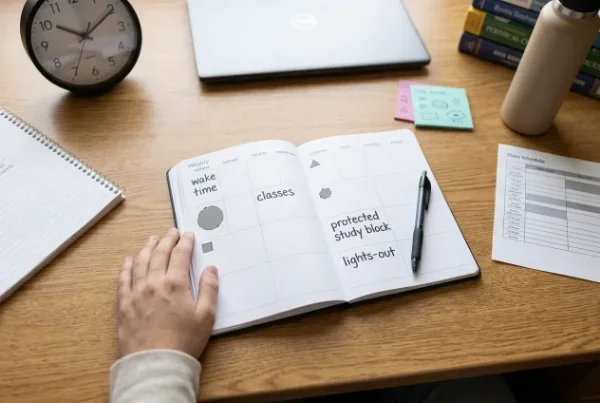
An ADHD schedule for college students is a weekly plan built on 4 fixed anchors: wake time, classes, 1 protected study block, and lights-out. Buffer time between them covers for time blindness, the ADHD habit of misjudging how long things take, so 1 missed block doesn't wreck the day.
You're not rare. In ACHA's Spring 2026 National College Health Assessment, 15.6% of 57,211 college students said they'd been diagnosed with ADHD. I think the usual hour-by-hour template is why students drop their plans by midterms.
What Should an ADHD Schedule for College Students Look Like?
Anchors with white space around them.
Wake at 8:00 AM every weekday.
Classes stay where the registrar put them.
Study 90 minutes in 1 spot, at 2:00 PM MWF and 3:30 PM TTh.
Lights-out at 11:30 PM.
Everything else floats, with 20-minute buffers.
Hour-by-hour plans assume you know how long tasks take. A 2022 meta-analysis of 55 studies led by Ivo Marx found people with ADHD did worse on every type of timing task tested. That's time blindness, measured.
I'm leaving medication timing out on purpose. That's your prescriber's call.
Make Your Week Visible
Keep your ADHD schedule visible without opening anything, on a whiteboard or your lock screen.
Color-code everything. Let me walk that back. 4 colors let you read a week at a glance, and 12 turn your planner into a hobby. Paper suits students who ignore notifications. Apps suit students glued to their phones.

How Small Should You Break Down a 10-Page Paper?
Small enough that each piece fits 1 study block and starts with a verb. Our coaches call these micro-goals.
Pull 3 sources into 1 folder.
Write a 5-line outline.
Draft the ugliest first page you can.
Draft 1 section per study block.
Edit, then read it out loud.
A college freshman who worked with The Ladder Method learned this. Grades and confidence both rose.
Time Your Breaks, but Pick Your Own Number
Let a timer call your breaks. In a 2023 Maastricht University study of 87 students, those who paused at will reported more fatigue and less focus. They also took longer to finish the same work.
The timed groups used 24-minute or 12-minute blocks, so Pomodoro's 25 isn't sacred. Try 12 on reading you dread. If hyperfocus hits, let it run, then take a 15-minute break. That's my first tweak to Pomodoro with ADHD.

Where Should You Study If Your Dorm Is the Distraction?
Somewhere that's only for studying, with your phone out of reach. A library carrel beats the desk where you eat and game. StayFocusd or Freedom can block your worst sites.
Or try body doubling, working beside someone else who's working. For some students with ADHD, that holds focus when blockers don't.
Book Exercise Like It's a Class
Regular exercise earns a fixed slot once your 4 anchors hold. An October 2025 review in Psychiatry International covered 10 exercise studies on adults with ADHD, and 9 found better inhibitory control. That's the brake that keeps your hand off your phone. Nobody knows which workout is best yet, so pick one you'll repeat.
Write Reminders as Next Steps
Every reminder should name the task and the place. "2:00 PM, carrel, chem set 4" gets you moving, and "Study" gets snoozed. Alarms fade into background noise, so change the sound every 2 weeks.
Run a 15-Minute Review Every Sunday
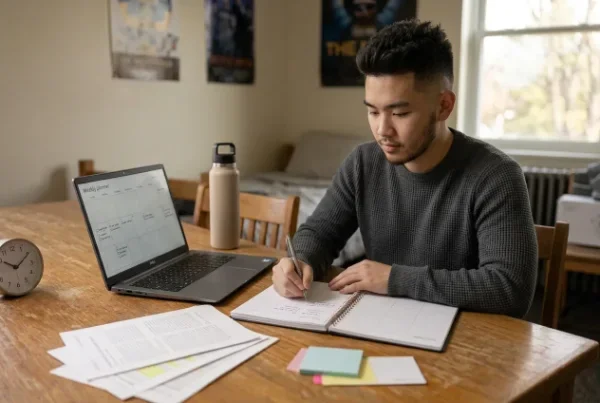
A 15-minute Sunday review fixes next week's schedule before it starts.
Mark each anchor as kept or missed.
Move any anchor you missed 3 times. The time was wrong.
Copy the week's deadlines from each syllabus.
Pick 1 change and stop there.
If It Keeps Breaking, Borrow Structure
After 4 weeks of slipping anchors, add outside structure.
In a 4-year study of 406 students, 59.1% of those without ADHD stayed through 8 semesters or graduated, against 49% of unmedicated students with ADHD. Planning and self-control skills (executive function) and campus academic support were among the top predictors.
That's the gap our coaching for college students fills. In our experience, most clients notice a difference within 4-8 weeks. Borrowing structure is normal. And if your anchors hold on your own, you don't need us.
The best ADHD schedule for college students leaves room to miss a block. Pick your 4 anchors tonight.
Frequently Asked Questions
What is the best ADHD schedule for college students?
The best ADHD schedule for college students uses 4 fixed anchors each day, which are wake time, classes, 1 protected study block, and lights-out. Everything else stays flexible, with about 20 minutes of buffer after each anchor. The buffer matters because a 2022 meta-analysis of 55 studies found people with ADHD did worse than their peers on every type of timing task tested.
How common is ADHD among college students?
It depends on what's being measured. A 2009 review led by George DuPaul estimated that 2% to 8% of college students report clinically significant ADHD symptoms. In the Spring 2026 ACHA National College Health Assessment, 15.6% of 57,211 college students said they'd been diagnosed with ADHD at some point. The first figure counts current symptoms, the second counts any past diagnosis, and the review came out 17 years before the survey.
Does ADHD affect college graduation rates?
It can. In a 4-year study of 406 students published in 2021, 59.1% of students without ADHD stayed enrolled through 8 semesters or graduated, compared with 49% of students with ADHD who weren't taking medication. Students with ADHD also earned lower GPAs. Stronger executive function skills and campus academic support were among the best predictors of who did well.
How long should a college student with ADHD study before taking a break?
Start with 12 to 25 minutes of work, then take a 3 to 6 minute break. A 2023 Maastricht University study of 87 students found that timed breaks led to less fatigue and more focus than taking breaks at will, and students finished the same work faster. If hyperfocus kicks in on work you like, let the block run and take a longer break afterward.
Does an ADHD schedule for college students need to change every semester?
Yes, because class times change every term and your study block and wake time have to move with them. Rebuild your anchors in the first week of classes, then use a 15-minute Sunday review to adjust.
Can an executive function coach help a college student with ADHD stick to a schedule?
Yes, when a schedule keeps falling apart without someone checking in. Coaches at The Ladder Method meet with college students weekly or biweekly, build planning systems with them, and step back once the student runs those systems alone. Most of their clients notice improvement within 4 to 8 weeks.