What To Expect From Executive Function Coaching: 5 Truths And 1 Lie
Most parents picture executive function coaching the way they picture tutoring. You book weekly sessions, and the grades climb by winter. What to expect from executive function coaching is different. The coach works on your child's real assignments, you keep the plan running at home, paper tools come before apps, and habits that hold without you take months to set.
Executive function coaching, or EF coaching, is weekly, 1-on-1 practice in the skills that run a school day, like planning, starting tasks, tracking time, and keeping materials organized. The coach teaches a strategy, the student uses it on real homework, and the family keeps it going between sessions. First changes can show up in weeks. Lasting habits take months.
The Ladder Method has provided executive function coaching for more than a decade, to students from elementary school through college, in person and online across the US.
This guide is for parents of K-12 students. It won't cover medication, which belongs with your child's prescriber. It also skips adult executive function coaching, because adults run their systems alone and the rules change.
A warning first. The Attention Deficit Disorder Association says the coaching profession isn't regulated, so anyone can call themselves an ADHD coach, and the same goes for executive function coaches. Before you sign with anyone, ask 4 questions. What training did you complete? How will you work with my child's school? How will we measure progress? Will you promise results by a certain date? (The right answer to the last one is no.)
Kids need EF coaching or other outside help because the brain wiring behind these skills is still developing.
You've probably heard that the prefrontal cortex, the planning center behind the forehead, finishes growing at 25. That number doesn't hold up. University of Cambridge researchers analyzed brain scans from 3,802 people aged 0 to 90 and found adolescent-style wiring changes across the whole brain running to about age 32. The paper came out in Nature Communications in November 2025.
Not everyone buys that number either. Researcher Jenn Dowd pointed out in December 2025 that the study compared different people at different ages, which can't show how a single person's brain changes over time. So scratch the idea of a finish line. The better way to say it is that these skills keep developing through the teen years and well into adulthood. That's why a 14-year-old's messy backpack is often a stage and not a character flaw.
For kids with ADHD, the clock runs later. A National Institute of Mental Health study published in PNAS in 2007 compared 223 children with ADHD and 223 without. The age at which half the cortex hit peak thickness was 10.5 in the ADHD group and 7.5 in the others, and the biggest lag sat in the front of the brain. That 3-year gap in childhood is a reason the chore chart that works for one sibling can flop for the other.
ADHD is common, too. The CDC estimates about 7 million US children ages 3 to 17, or 11.7%, had a current ADHD diagnosis in its 2024 parent survey. Plenty of kids without a diagnosis need the same EF coaching.
Truth 1: Parents Can't Outsource Executive Function Coaching
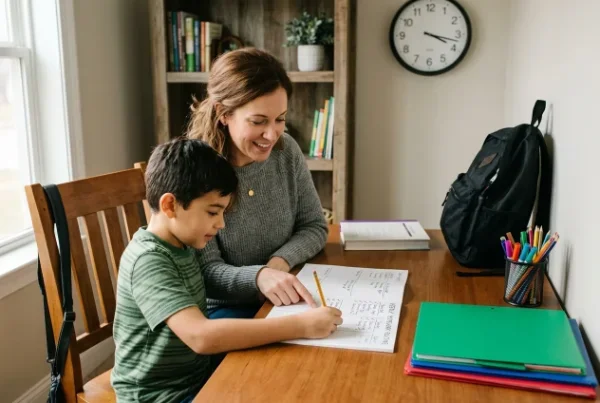
You can't hand this work to a coach and step back. An executive function coach might see your child for an hour a week, and the skills have to hold up during the other 167 hours.
The strongest evidence for parent involvement comes from young kids. For children under 6 with ADHD, the CDC says experts recommend behavior therapy before medication. The most effective type at that age is parent training, where therapists teach parents the skills to use at home, and the CDC says it works as well as medication for young children. That's therapy, not EF coaching, but the logic carries straight over. A parent who runs a steady 4 p.m. homework routine shapes the week more than any 1-hour session can.
Good EF coaching starts with an honest look at your home. When and where does homework happen, and who checks the planner when you're at work? An EF coach needs those answers before building anything, and some of them sting. Parents own part of the system. A coach who never asks about it is guessing.
The skills also stick better in the room where your child will use them. Planning in an office and then doing homework at the dining table adds a step, because your child has to remember the plan and carry it across town. That's a big ask for an 8-year-old. Online sessions have a real advantage here, since your child can meet the coach from the same desk where homework happens.
Agree on what success looks like before session 1. "Better grades" is too vague to track. "Turns in 9 of 10 assignments on time by Thanksgiving" is a goal a family can check every Friday. Keep an eye on the line between normal and not, too. Some disorganization is normal at every age, but if it's getting worse or sinking grades even when your child is trying hard, ask your pediatrician about an evaluation.

Truth 2: Skills Stick When Coaching Uses Your Child's Real Assignments
Executive function coaching works best on the homework already in your child's backpack. A strategy practiced on a worksheet about imaginary tasks rarely shows up when the real essay is due.
I'll say the unpopular part. Brain-training games are a poor use of money for this problem. Monica Melby-Lervåg and Charles Hulme's 2013 meta-analysis in Developmental Psychology found working memory training improved the trained tasks and little else. Their 2016 follow-up concluded there's no convincing evidence it produces general cognitive benefits. Your child gets better at the game. The math homework stays late.
Keep the goals few and specific. Work on 2 at a time, 3 at most, because each new routine needs daily repetition before it runs on its own. Good goals sound like "writes every assignment in the planner before leaving school" or "starts homework by 4:30 on weekdays." When one sticks, add the next.
EF coaching isn't tutoring, though good setups connect the 2. The 3 services parents mix up split this way.
Tutoring covers the subject itself, like fractions or essay structure.
An executive function coach works on how the work gets planned, started, and finished in every class.
Therapy handles the emotional side, such as anxiety or low mood, when that's what's blocking the work.
If your child needs content help too, sort out academic coaching versus tutoring before you book both.
Big school projects make ideal practice. A science fair board or a college application is a project with a deadline, and planning backward from that deadline is exactly the skill EF coaching builds. A 5-page history paper due in 3 weeks becomes 6 dated steps on a calendar. The skill carries into every class because it was learned on a real one.
There's never a perfect month to start. Summer has open time but competes with camp and travel, and the school year has real deadlines but less slack. I'd start during the school year and practice on real due dates rather than wait for a clean slate that never comes.
Truth 3: Every Adult in Your Child's Week Has to Run the Same Plan
The adults around your child need to run a single shared plan. When parents, teachers, tutors, and coaches each use a different system, a smart kid finds the gaps and slips through them.
This isn't a knock on your child. Bright, disorganized kids are often skilled negotiators. Mom thinks the tutor checked the planner, the tutor thinks the teacher did, and the assignment quietly disappears. An executive function coach who meets on Tuesday can't enforce a Thursday deadline alone. Someone at home has to know the Thursday deadline exists.
More help isn't always better help. A child with 4 appointments a week across 3 offices makes at least 8 extra transitions, and each switch costs attention that a kid with ADHD doesn't have to spare. Consolidate where you can. A single coach who talks to the school beats 3 specialists who never compare notes.
So name a single adult as the point person. Give the teacher a 1-page summary of the plan, use the same planner format at school and at home, and book a 10-minute check-in with the EF coach every 2 weeks. That's the whole job. It's small, and it's the part most families skip.
Truth 4: In 2026, Paper Still Comes Before Apps
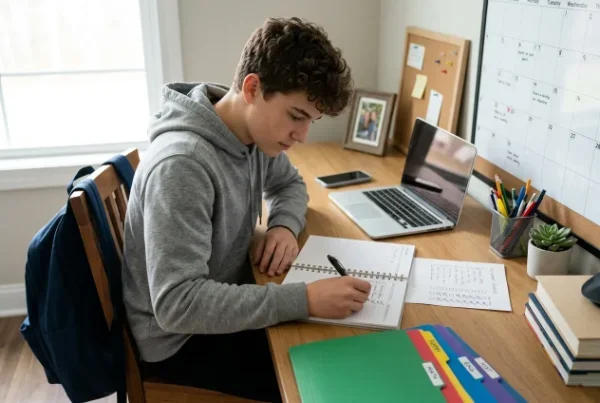
Start with a paper planner, a wall calendar, and folders, then add digital tools once the paper system runs without reminders. Kids are fluent with phones, and that fluency rarely extends to school portals, email, and shared calendars.
Phones also come loaded with distractions. Common Sense Media tracked the phones of about 200 kids ages 11 to 17 for its 2023 report and found more than half got 237 or more notifications a day. About 23% of those alerts landed during school hours, and the median student spent 43 minutes on the phone during the school day. A planner app lives on that same device.
The school portal causes its own problem. Teachers post everything online, so kids assume someone else is tracking it. That someone is usually you. If your 7th grader ignores your calendar invites, that's normal, because nobody taught the skill and nobody is checking it.
A well-studied organization program for kids with ADHD runs mostly on paper. Organizational Skills Training was tested in a randomized trial led by Howard Abikoff and published in 2013. It used a paper assignment record, a test and assignment calendar, an accordion binder with sections for parents and teachers, and a backpack checklist. Kids in grades 3 to 5 met for 20 sessions, twice a week for 10 weeks. Organization, homework, and grades improved, parents reported less conflict, and teachers who weren't part of the program still saw the gains the next school year.
The note-taking research is messier. Mueller and Oppenheimer's widely shared 2014 study in Psychological Science concluded that longhand notes beat laptop notes. A 2019 direct replication by Morehead, Dunlosky, and Rawson in Educational Psychology Review found no consistent difference. So I wouldn't sell paper on memory claims. I'd sell it on visibility. A wall calendar can't hide behind a notification.
Filing follows the same paper-first order. A child who keeps a paper folder for each class, labeled the same way every year, has an easy time building digital folders with the same names later. Visual planners are part of how The Ladder Method's coaching for younger students handles organization.
An EF coach should walk your child through these planning steps in order.
Every assignment goes in the same place, every day, before your child leaves class.
Map the whole week on a single page, including practices, games, and family plans.
Any project longer than 3 days gets broken into dated steps, planned backward from the due date.
Before starting a task, your child guesses how long it'll take, then times it.
Decide what "done" means up front, with a short checklist for proofreading and packing the bag.
Digital calendars come last, once the paper version has run for 4 straight weeks. (That's my rule, not a study's.)

Truth 5: What Belongs in a Homework Station, on the Desk and on the Screen?
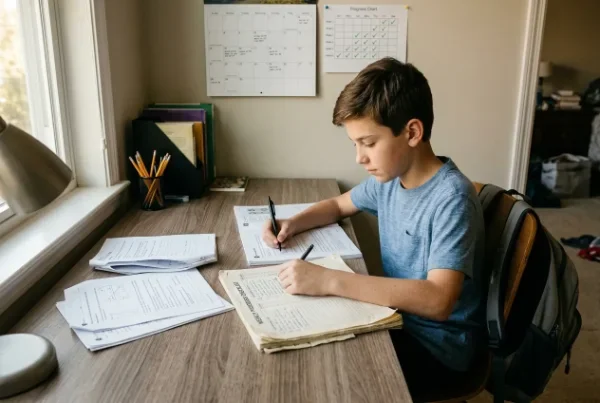
A homework station needs a desk sized for your child, every supply within reach, and a screen big enough to show 2 documents side by side. Every trip to find a pencil is a fresh chance to drift off task.
What's on the wall matters too. Carnegie Mellon researchers taught 24 kindergartners in a heavily decorated room and in a bare one for a 2014 study in Psychological Science. In the decorated room, kids spent 38.6% of their time off task and scored 42% on the learning tests. In the bare room, those numbers were 28.4% and 55%. Keep the wall in front of the desk plain.
Stock the desk once, then restock on the first of every month.
Pencils, erasers, a sharpener, pens, and highlighters
Sticky notes in 2 or 3 colors, tape, scissors, and a ruler
A small whiteboard for today's checklist
Lined and graph paper, plus math manipulatives for kids in K-5
The screen needs the same attention. A laptop screen is too small for long stretches of work in grades 4 through 12, and it's hard to proofread an essay while the rubric sits in another tab. Plug in a second monitor, or run an HDMI cable to a TV you already own. Then add a basic black-and-white laser printer and a bulletin board, because a printed rubric stays visible after the laptop closes.
Put a big wall calendar or whiteboard within sight of the desk for the month's deadlines. The ideal study space doesn't need to look like a catalog photo. It needs to work at 7 p.m. on a Tuesday, when your child is tired and the paper is due Wednesday.
Your child works on paper and on screens every day, so both setups need attention at the same time. A good EF coach will ask to see both in the first month.
The Lie: Executive Function Coaching Is a Quick Fix. How Long Does It Take?
First changes often show up within 4 to 8 weeks, which is the window The Ladder Method's executive function coaches report for most clients. Habits that run without reminders take longer, often months longer.
The habit research backs this up. Lally and colleagues found a median of 66 days for a new daily habit to feel automatic, in a 2010 study in the European Journal of Social Psychology. Individuals ranged from 18 to 254 days. A 2024 meta-analysis in the journal Healthcare, from University of South Australia researchers, pooled more than 2,600 people and found a median of 59 to 66 days, with a range from 4 to 335.
Both studies tracked adults building health habits like exercise and eating, not kids building homework routines. I'd treat those numbers as a floor for a child with ADHD.
The organization program from Truth 4 ran 10 weeks, and its gains held into the next school year. That's the shape good executive function coaching takes. It's steady work for a season, then less support each month as your child takes over. At The Ladder Method, clients graduate once they can run the strategies on their own.
So be wary of any program that promises a fixed result by a fixed date. Building a habit takes longer than 21 days, and families who know that going in are the ones who don't quit in week 6.
Judge EF coaching by the reminder count. If your child needs fewer prompts this month than last month, it's working, even before the report card shows it.
The Ladder Method's coaches come from education, psychology, and learning science, and each one trains in The Ladder Method framework before working with families. The process starts with a consultation, then a match with the coach who fits your child, then weekly or biweekly sessions with regular parent check-ins.
Book a consultation and bring your child's planner, the school portal login, and a recent missed assignment. Knowing what to expect from executive function coaching is what keeps families going past week 6, which is right around when the first real changes show up.
Frequently Asked Questions
What should you expect from executive function coaching in the first 2 months?
Expect an intake conversation, 2 or 3 measurable goals, and weekly or biweekly sessions built on your child's real assignments. The Ladder Method reports that most clients notice first improvements within 4 to 8 weeks. Habits that run without reminders take longer, with a median of 59 to 66 days in a 2024 meta-analysis of adult habit formation.
How long does executive function coaching take to work?
There's no fixed length, and a program that guarantees one is guessing. In a randomized trial led by Howard Abikoff, 3rd to 5th graders with ADHD met for 20 sessions of organizational skills training over 10 weeks, and the gains lasted into the next school year. Plan on at least a full semester of steady work, with support tapering as your child takes over.
What should parents expect to do between executive function coaching sessions?
Parents keep the system running between sessions by checking the planner, holding homework to a set time, and telling the coach what broke. For children under 6 with ADHD, the CDC says experts recommend behavior therapy first, and the most effective type at that age is parent training.
What's the difference between an executive function coach and a tutor?
A tutor teaches a subject, like fractions or essay structure. An executive function coach teaches how to plan, start, organize, and finish the work in every class, and some students need both.
Do brain-training apps improve executive function?
Not in a way that carries over to schoolwork. Melby-Lervåg and Hulme's 2013 meta-analysis found working memory training improved the trained tasks, and their 2016 follow-up found no convincing evidence of broader cognitive benefits. Practice on real assignments is a better use of your child's time.
How do I know if an executive function coach is qualified?
Ask what training the coach completed, how they'll work with your child's school, and how progress will be measured. The Attention Deficit Disorder Association notes that the coaching profession isn't regulated, so anyone can call themselves an ADHD coach. A qualified coach answers those questions clearly, involves you in setting goals, and never guarantees results by a set date. Treat a promised timeline as a warning sign.