ADHD Coaching Vs Therapy: Which Do You Need First?
ADHD coaching vs therapy comes down to what's in your way. If you know what to do and can't make yourself do it, that's a coaching problem. If anxiety, low mood or years of shame keep you stuck, that's a therapy problem. A coach can't diagnose ADHD, and a good one won't pretend to.
ADHD coaching is an unlicensed, skills-based service that helps you plan, start tasks and follow through, for about 6 months on average. ADHD therapy is a licensed clinical service that treats ADHD symptoms plus problems like anxiety or depression, often using cognitive behavioral therapy. Health plans often cover therapy and rarely cover coaching.
We run a coaching practice, and we'll still tell you when therapy should come first.
We won't cover medication or evaluations, since those belong with a prescriber or psychologist.

How Is ADHD Coaching Different From Therapy?
Therapy treats a condition. Coaching trains a routine.
The usual shorthand says coaches handle productivity and therapists handle feelings. Close, but not exact. CBT, a common talk therapy for ADHD, teaches planning and organizing skills too. So the cleaner line is legal. A therapist holds a license to treat psychiatric conditions. A coach doesn't, and should refer out.
We've coached kids, teens and adults for more than 10 years, and about 70% of our clients are neurodivergent. We draw the same line for executive function coaching, which needs no diagnosis.

What Does an ADHD Coach Do?
An ADHD coach works with you on planning, starting and finishing tasks, then checks that the plan held between sessions.
Nobody needs a license to do it. CHADD, the national ADHD nonprofit, says anyone can start a coaching practice. JAMA Network Open published a study that surveyed 481 coaches. More than 60% entered the field after COVID hit, and most reported no clinical training.
Where Coaching Does Its Best Work
Coaching works best on the gap between knowing and doing. It's the adult with 3 planners who uses none. It's the 10th grader who understands the essay prompt at 4pm and opens the file at 11pm. Most of our clients notice a change within 4 to 8 weeks.
The research is thinner than coaches admit. Of 19 coaching studies in a 2018 review, only 2 were randomized trials, and 3 of its 4 authors were coaches. An adult study in the American Journal of Lifestyle Medicine found medium to large gains from 12 sessions, but it had no control group. So whether ADHD coaching works is still an open question, and vetting the coach matters more.

Where Therapy Fits in ADHD Care
ADHD therapy works on core ADHD symptoms plus the anxiety, depression, relationship strain and shame that build up around them. Often that means CBT, a structured talk therapy that pairs thought work with practical skills.
Therapy is also where common comorbidities, conditions diagnosed together with ADHD, get treated. CHADD notes coaches aren't trained for those unless they're also licensed clinicians.
The Evidence Gap Favors Therapy
Therapy has far more evidence behind it. Cochrane's 2018 review covered 14 randomized trials with 700 adults. The review found CBT may ease ADHD symptoms in the short term, though the evidence quality was low.
The Lancet Psychiatry ran a bigger analysis in December 2024, covering 113 trials and 14,887 adults. CBT improved symptoms on clinician ratings at 12 weeks, and so did mindfulness and psychoeducation. Only stimulants and atomoxetine, both medications, moved patients' own ratings.
ADHD Coach vs Therapist at a Glance
Therapists are licensed, treat co-occurring conditions and can often bill insurance. Coaches do none of that and usually stay longer.
| Coach | Therapist | |
|---|---|---|
| Typical length | About 6 months | About 12 weeks for a structured course |
| Insurance | Almost never | Often, if you can find someone in network |
| Strongest evidence | 2 randomized trials among 19 studies (2018 review) | 14 randomized trials in adults, low-quality evidence (Cochrane, 2018) |
| Main job | Planning, time, starting tasks, follow-through | ADHD symptoms, anxiety, depression, mood, relationships |
| Credential | None required in the US | State license (psychologist, LCSW, LMHC and others) |
| Diagnosis | Never | Psychologists and psychiatrists, yes. A New York LMHC needs an extra state privilege |
| Prescriptions | Never | Psychiatrists yes, most therapists no |

How Can You Tell Which One You Need?
Choose by what's stopping you now. On a good day, do you get things done?
If yes, and the bad days trace back to mood, anxiety or shame, start with therapy. If even your good days fall apart at planning and follow-through, coaching is the better first step.
Execution Problems Point to a Coach
Book a coach first when the problem is execution. Maybe you start every project the night before, even when you know what it needs. Maybe the calendar exists, but nothing on it happens on time. Or you take a stimulant, your attention is better, and you still miss 2 deadlines a month.
Parents see a version of this at home, in a teen who understands the material and can't manage the workload. At The Ladder Method, we keep parents in the loop with regular check-ins. CHADD notes that coaching for kids may need to work "simultaneously or exclusively with parents."
Clinical Blocks Need a Therapist First
Start with a therapist when something clinical is doing the blocking. Anxiety that freezes you before you begin. Depression that drains the reason to begin. Trauma, substance use, unsafe behavior or a crisis at home. If you need a diagnosis or medication, see an evaluator or prescriber first. If you're in crisis, call or text 988.
Young kids often start here too. The CDC recommends behavior therapy before medication for children under 6, and says it works best when parents deliver it.
Is Doing Both at Once a Mistake?
At the start, usually. The standard advice is "do both." We'd sequence them.
The reason is follow-through. Both services run on the work you do between sessions. Stack 2 weekly appointments, 2 sets of homework and 2 bills on an ADHD brain, and something drops. Usually it's whichever feels less urgent that week.
Our rule of thumb:
When shame, anxiety or low mood stops you from starting, go to therapy first. Add coaching once a 12-week CBT course takes the edge off.
Coaching goes first when you know what to do and still don't do it. Therapy joins later only if something clinical shows up.
Both at once can work right after a diagnosis, if your therapist, prescriber and coach share notes through a signed release.
What Insurance Covers in ADHD Coaching vs Therapy
Therapy can often run through your health plan, and coaching almost never does. Coverage on paper and coverage in practice aren't the same thing, though.
Start with the deductible. KFF's 2025 survey found 88% of workers with single coverage have one. If your plan applies it to therapy visits, you pay the plan's rate for each session until you meet it, so a 12-week course early in the year can come mostly out of your pocket. And 34% of psychologists accepted no insurance at all in the American Psychological Association's 2024 survey.
Length is the other difference. The lead researcher behind the JAMA Network Open survey puts coaching at about 6 months on average, against roughly 12 weeks for a structured therapy course.
Coaching also doesn't appear in IRS Publication 502, the IRS guide to medical expenses, so check with your FSA or HSA before counting on it.
The longer commitment is worth it for an execution problem. For a clinical one, it's time spent on the wrong fix.
What Should You Check Before Booking ADHD Help in NYC?
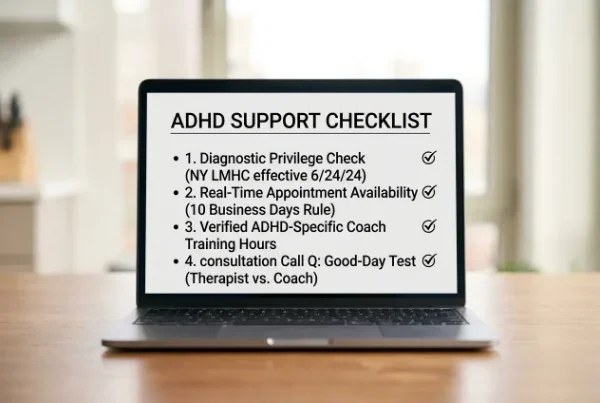
Check 3 things before you book.
Diagnosis rights. A licensed mental health counselor (LMHC) in New York can diagnose only with a separate state privilege, in place since June 24, 2024. Earning it takes 2,000 hours of supervised client work that includes diagnosis, or 36 months of supervised experience for counselors licensed before that date.
Real availability. A 2023 secret-shopper survey by the state attorney general found 86% of 396 listed in-network mental health providers were unreachable, out of network or not taking new patients. Under New York Department of Financial Services rules, state-regulated plans must now offer a first outpatient mental health appointment within 10 business days, with commercial policies phasing in as they renew on or after July 1, 2025. If they can't, file an access complaint. The plan then has 3 business days to find someone in network or approve an out-of-network provider at in-network cost-sharing. Self-funded employer plans and Medicare are exempt, so ask HR which kind you have.
Coach training. Ask for a credential and for ADHD-specific training. ICF credentials start at 60 hours of training and 100 hours of coaching, and none of it has to involve ADHD.
Our ADHD coaching in NYC works with kids, teens and adults, in person and online.
Start With What's Stopping You
Run the good-day test first. Good days that work and bad days wrecked by mood or anxiety point to a therapist. Good days that still fall apart at planning point to a coach. Either way, don't start both in the same week. That one question settles ADHD coaching vs therapy for most people, and it's a good way to open a consultation call.
Frequently Asked Questions
How do I decide on ADHD coaching vs therapy as an adult?
Look at your good days first. Mood or anxiety behind the bad days points to therapy, and planning that fails even on good days points to coaching. CBT has more research, with 14 randomized trials in adults in a 2018 Cochrane review, though the evidence was low quality.
Who can diagnose ADHD in New York?
Psychologists and psychiatrists can, along with other licensed medical providers. A licensed mental health counselor needs a separate state diagnostic privilege, available since June 24, 2024. An ADHD coach can't diagnose at all.
Can I use an FSA or HSA to pay for ADHD coaching?
Sometimes, but plan on questions. IRS Publication 502 never mentions coaching, so an FSA may require a letter of medical necessity from your doctor. With an HSA, you're responsible for proving the expense qualifies if the IRS asks.
How long does ADHD coaching take compared with therapy?
Longer, as a rule. A JAMA Network Open survey of 481 coaches found engagements average about 6 months. Structured therapy courses run roughly 12 weeks, per the study's lead researcher.
Is the ADHD coaching vs therapy choice different for kids?
Yes, especially for young children. The CDC recommends behavior therapy before medication for kids under 6, ideally delivered by parents, and often behavior therapy plus medication for older children. Coaching fits teens who understand the work but can't manage it.
What credentials should an ADHD coach have?
Look for a coaching credential plus ADHD-specific training, since no license exists. ICF's entry level, the ACC, requires 60 hours of training and 100 hours of coaching, none of it necessarily about ADHD. Ask for their ADHD client count from the past year.