Parents With ADHD: A Guide To Raising Kids Ages 2 To 18
Parents with ADHD raise kids best when the house does the remembering. Put the schedule on the wall, the timer on the counter, the backpacks in 1 spot by the door, and the consequences on paper before anyone gets upset. ADHD hits memory and patience hardest, so a plan that runs on either one breaks by Thursday.
This guide is for the parent who has ADHD, whether or not the kids do. If only your child has the diagnosis, start with our guide to parenting a child with ADHD.
Parents with ADHD are adults who have attention-deficit/hyperactivity disorder while raising children. ADHD weakens the skills parenting uses all day, including working memory, planning, time awareness and emotional control. The usual result is uneven follow-through and a short fuse. Both improve when routines move out of the parent's head and the parent's ADHD gets treated.
You have company. About 6.0% of US adults, roughly 15.5 million people, reported a current ADHD diagnosis in a CDC survey from late 2023, and 55.9% of them were diagnosed at 18 or older. If you found out as a grown-up, you're in the majority.
How Does ADHD Change the Way You Parent?
The repetitive half of parenting takes the biggest hit. An emergency grabs your full attention, while the 43rd request to put on shoes slides right past it.
The strain shows up in 7 places.
Your temper runs hot. In 1 study from a Frontiers in Psychiatry meta-analysis, 54.9% of adults with ADHD had extreme trouble regulating emotion.
By the 20th block tower, play gets boring and your attention drifts to your phone.
Planning ahead takes executive function you're short on, like spotting that Tuesdays always fall apart and then changing Tuesday.
Permission slips, shin guards and dentist reminders pile up, and working memory drops them one at a time.
Supervision drifts. A 90-second phone check is harmless with a 12-year-old and risky with a 2-year-old near the stairs.
Kids repeat behavior that gets noticed right away, and calm moments are the easiest to miss.
Rules wobble when you set one on Monday, forget it by Wednesday and enforce it hard on Friday. Your kid learns the rule is a coin flip.
Now the part the guilt leaves out. A 2017 meta-analysis of 32 studies led by Joanne Park found parental ADHD symptoms explained 2.9% of the variation in harsh parenting, 3.2% in lax parenting and 0.5% in positive parenting. The link is real, and it's small. I'd move the rest of the worry into systems, because systems are the part you control.
Your kid may have ADHD too. A 2019 review of 37 twin studies by Stephen Faraone and Henrik Larsson put the average heritability of ADHD at 74%. A 2023 meta-analysis in World Psychiatry found about 32% of children of parents with ADHD had it themselves, against about 3% of children whose parents didn't.
Most advice says to be consistent. I'll push back on that, or at least on the phrasing. Consistency is the right outcome and the wrong instruction, because it asks for the exact skill ADHD takes away. Aim for fast repair instead.
Say you snap at 5:15 over shoes on the stairs. Go back by 5:30, name what happened in 1 sentence, and restate the rule calmly.
Parenting With ADHD, Age by Age
Each stage presses on a different ADHD weak spot. Toddlers test your supervision, grade schoolers your calendar, tweens your patience and teens your follow-through. Our age-by-age support guide covers the child's side.
Toddlers and Preschoolers (Ages 2 to 5)
Set up the house so a lapse in attention can't hurt anyone, then keep the rules short.
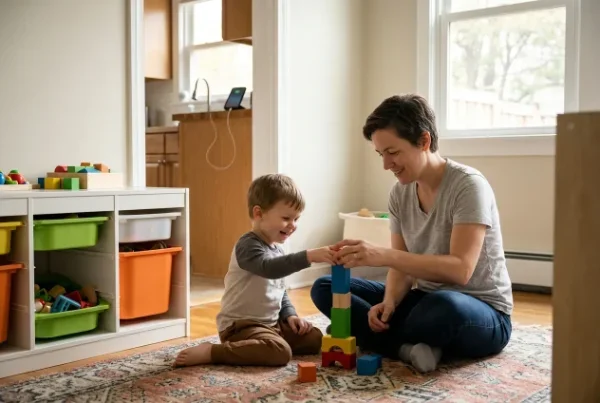
Block 15 minutes of floor play on a timer, with your phone charging in the kitchen. A timer gives "be present" an end point, which makes it easier to stick with.
A "yes space" (a gated room or corner with nothing sharp, high or toxic) means a 90-second text can't turn into an accident.
Pack 2 go-bags with diapers, spare clothes, snacks and 1 small toy. Keep one in the car and hang the other by the door, then restock both on Sunday night.
A picture schedule on the fridge (wake up, teeth, breakfast, car, nap) reminds you as much as it reminds them.
Narrate good behavior the second you see it. "You put your cup in the sink. Thank you." Short, specific praise is the cheapest discipline tool you own.
Choose 2 consequences ahead of time, such as a 3-minute time-out or losing the next show. Give 1 warning, then follow through within a minute, while you still remember why.
For kids under 6 with ADHD, the CDC notes that the American Academy of Pediatrics recommends parent training in behavior management before medication. Whether it works as well when the parent has ADHD is less settled. In Edmund Sonuga-Barke's 2002 study of 83 children aged 3, those whose mothers had high ADHD symptoms didn't improve after 8 weeks of parent training. A 2017 study of 164 families found parent ADHD symptoms reduced results in only 1 of 16 analyses. My read is to sign up anyway and treat your own ADHD at the same time.

The Grade School Years (Ages 6 to 10)
Put every plan where you can both see it, since a spoken plan fades from your memory first.
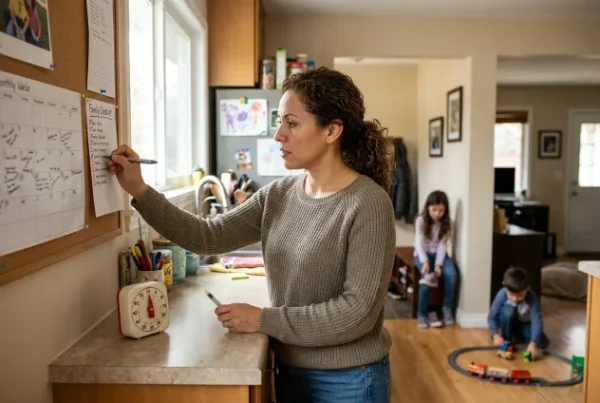
Hang a whiteboard in the kitchen or share a color-coded digital calendar for practices, tests and birthday parties.
Set 2 homework "office hours," say 4:15 and 4:45, instead of answering questions every 3 minutes. Clear the desk first, with supplies in 1 caddy and no screens in reach.
Every Sunday, spend 10 minutes on the week's plans, then set 2 reminders per event, 3 days out and the morning of.
Hobby gear goes where your kid can reach it without you, so practice doesn't depend on your memory.
Kids this age copy how you talk to a cashier or a coach, and they absorb whatever's on the TV.
What Do Tweens (Ages 11 to 13) Need From a Parent With ADHD?
A weekly ritual with no agenda. Protect it, and save the hard conversations for it.
Pick something repeatable, like Saturday pancakes or the Thursday drive to practice. Skip the lectures and the report-card review, since the ritual is where your tween learns you're safe to talk to.
Before a talk about puberty or social media, type 3 talking points into your phone and deliver them in a flat, calm voice. Winging it is how ADHD impulsivity says the thing you regret.
An organization skills program or an executive function coach can set up your tween's folder and planner system. Copy it for your own desk.
Decide once, in writing, how chores connect to allowance, because renegotiating every Saturday burns attention you don't have.
Every phone charges in the kitchen after 9 p.m., yours included.
The Teen Years (Ages 14 to 18)
Put the big rules in a signed contract. Paper remembers what you won't.
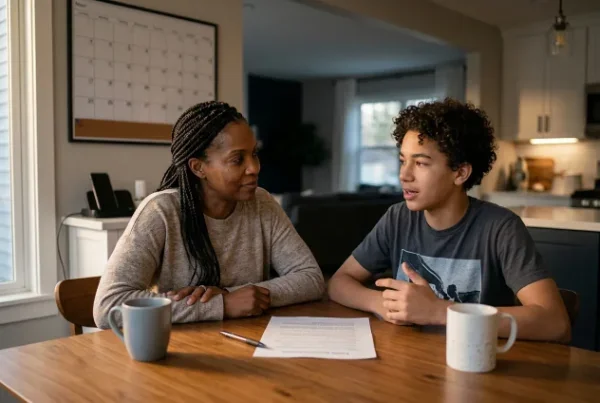
Write 1 contract covering money, phone and car. List what earns each privilege and what costs it, sign it together, and set a monthly calendar alert to review it.
Praise the boring wins out loud, like the receipt handed over, the curfew met and the phone on the charger at 10.
Adopt an honesty rule, where the truth always costs less than getting caught in a lie, so your teen has a reason to call you from a party gone wrong.
Some risk-taking is normal at this age. Validate the feeling, then name the 2 or 3 lines that don't move.
Choose the 3 events per season your teen cares about most, put each in your calendar with 2 alerts, and show up.
Which Self-Care Habits Matter Most for Parents With ADHD?
Sleep, treatment and help with logistics matter most. The rest of a self-care checklist can wait on a hard week, but keep meals and your own doctor's appointments, since a skipped lunch or a 5-hour night makes ADHD symptoms louder by dinner.
Get it out of your head. Use 1 shared calendar, 1 launch pad by the door and an alarm for every pickup. For parents with ADHD, a task that lives only in memory is a task already forgotten.
Treat your own ADHD. In a 2025 pilot trial in The Journal of Clinical Psychiatry, 35 mother-child pairs who both had ADHD tried different treatment orders. Parent training first, then the mother's medication, did best for child symptoms and positive parenting. A 2014 trial of 20 parents found stimulant medication brought more praise and less negative talk, though not every parenting behavior improved. Which medication fits depends on your health history, so that call belongs to your prescriber and this guide won't make it. Coaching builds routines, and therapy works on emotions and history.
Hand off what you keep dropping. Our Family Team Coach works with parents, nannies and guardians on school portals, supply systems and scheduling routines. If paying isn't an option, trade carpool days with another family for the same relief at no cost.
The First Thing to Change This Week
Pick the 1 moment that blows up most often in your house, maybe the 7:40 a.m. scramble for the bus, and move every step of it out of your head. Write the steps on the wall, stage the bags the night before, and set 1 alarm for 10 minutes before you need to leave. Then leave it alone for 2 weeks before you add a second routine.
The Ladder Method has coached students and adults on executive function for more than a decade, with weekly or biweekly sessions and regular check-ins with parents. If you'd like help building that first system, book a consultation.
The calmest homes run by parents with ADHD are the ones where the house carries the memory load. Start with 1 morning.
Frequently Asked Questions
Can Parents With ADHD Be Good Parents?
Yes. A 2017 meta-analysis of 32 studies in Clinical Psychology Review found parental ADHD symptoms explained about 3% of the variation in harsh and lax parenting, a real but small effect. Small trials also found that treating the parent's ADHD improved some parenting behaviors, including praise.
Will My Child Have ADHD if I Have It?
The odds go up, but it isn't certain. A 2023 meta-analysis in World Psychiatry found about 32% of children of parents with ADHD had ADHD, compared with about 3% of children whose parents didn't. Twin studies put the average heritability of ADHD at 74%.
Does Parent Training Work if the Parent Has ADHD?
Often, though the evidence is split. A 2002 study of 83 children aged 3 found no improvement after parent training when mothers had high ADHD symptoms, while a 2017 study of 164 families found parent ADHD symptoms reduced results in only 1 of 16 analyses. Treating the parent's ADHD alongside the training covers both possibilities.
Should Parents With ADHD Take Medication?
That decision belongs to you and a prescriber. In a 2014 double-blind trial, 20 parents with ADHD gave more praise and used less negative talk on stimulant medication, though not every parenting behavior improved. A 2025 pilot trial of 35 mother-child pairs found the best results when parent training came first and the mother's medication followed.
How Do I Stop Yelling at My Kids When I Have ADHD?
Plan the pause before you need it, with a set phrase like "I need 2 minutes," a spot to step away to, and a 15-minute window to come back and repair. Trouble regulating emotion is common in adult ADHD, and 1 study in a Frontiers in Psychiatry meta-analysis found extreme difficulty in 54.9% of adults with ADHD. Repair counts for more than a perfect record.
What Age Is Hardest to Parent When You Have ADHD?
It depends on your weakest skill. Toddlers are hardest if supervision is your gap, because ages 2 to 5 punish a wandering eye. Teens are hardest if follow-through is your gap, because a rule you forget to enforce is a rule a 16-year-old will test.
Can an Executive Function Coach Help a Parent With ADHD?
Yes, on the systems side. A coach helps set up calendars, routines and follow-through checks, and The Ladder Method runs sessions weekly or biweekly with regular progress check-ins. Coaching isn't therapy or medical treatment, so it works alongside both.