How Does A Concussion Or Head Injury Affect Executive Function?
A concussion disrupts executive function (planning, working memory, task initiation, self-monitoring and flexible thinking), and executive function is the slowest of the cognitive domains to come back. It is also the domain that standard return-to-play testing does not measure, which is why a student can be cleared to play and still be unable to write an essay.
That gap is the whole problem. Physical symptoms fade first. Reaction time recovers. The headache stops. The school work stays hard, and by then everyone has stopped watching.
Here is what the research shows about which parts of executive function a head injury hits, how long they take to recover, why school exposes the deficit more than sport does, and what actually helps.
Scope note. This page covers the school and executive function side of concussion recovery. Diagnosis, clearance and medical management belong with a physician. The Ladder Method provides executive function coaching, not concussion treatment.

The Short Answer
A concussion damages the connections between brain regions rather than a single spot, and executive function depends more on those connections than any other cognitive skill.
Planning, holding information in mind while you use it, switching between tasks, and catching your own mistakes all require the front of the brain to coordinate with regions elsewhere. That coordination is what a concussion disrupts. Individual skills can look intact when tested one at a time and still fail the moment they have to run together, which is what every school assignment demands.

What Executive Function Is, and Which Parts a Head Injury Hits
Executive function is the set of control skills that manage everything else your brain does. Concussion research points to disruption in 4 of them most often.
Working memory. Holding information in mind while you do something with it. Reading a paragraph and remembering the start of it by the end. Following a 3-step verbal instruction. This is usually the first thing a student notices and the hardest to hide.
Task initiation. Starting. Not wanting to start. Not intending to start. Actually beginning. A student who sits down at 7pm and opens the laptop at 9pm is not being defiant.
Cognitive flexibility. Switching between tasks or approaches, and changing method when the first one fails. After a concussion, students often lock onto one strategy and keep using it after it has stopped working.
Self-monitoring. Catching your own errors while you work. This one is quiet. The student does the work, does not notice the mistakes, hands it in, and gets a grade that does not match the effort.
Two more get hit and matter for school: sustained attention, and the sense of how long a task will take. Those 7 executive functions are the same set that coaching addresses in students without any injury history, which is why the rebuilding work looks similar even though the cause is completely different.

What Happens in the Brain
The frontal lobe does most of the executive work, and the dorsolateral prefrontal cortex is the region most often named in concussion research. A concussion is a diffuse axonal injury, meaning it damages the long fibers that carry signals between regions across the whole brain rather than only at the point of impact. Slowed, mistimed signalling between the front of the brain and everywhere else is the mechanism underneath every symptom in this article.
Imaging shows what that costs. A systematic review of task-based functional MRI studies in sport-related concussion, published in Frontiers in Neurology in January 2026, found altered recruitment of the frontoparietal control network in every one of its 15 included studies. Symptomatic athletes usually showed hyperactivation, meaning the brain recruited extra resources to hold performance steady. Youth athletes and those with persisting symptoms more often showed hypoactivation.
The finding that matters for parents is in the review's conclusion: those activation differences persisted after symptoms had resolved, in some studies up to 2 months after injury. The authors put it as functional recovery lagging behind clinical improvement.
Read plainly: a student can feel fine, test normal, and still be spending more brain resource than their classmates to produce the same page of work. That extra cost shows up as fatigue by fourth period, not as a symptom anyone writes on a form.
The Clearance Gap: What the Tests Measure and What They Miss
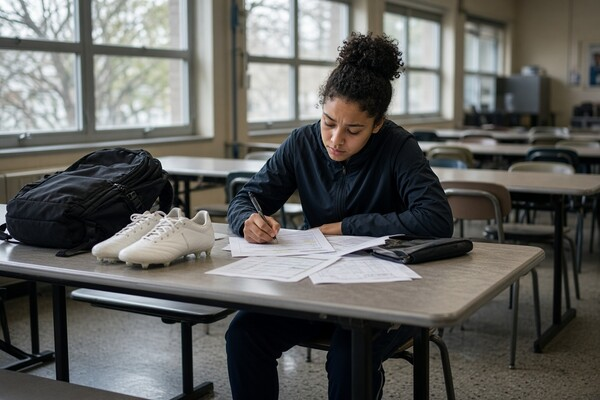
The standard neurocognitive battery used to clear student athletes does not report an executive function score.
ImPACT, the most widely used computerized test in US schools, returns 5 composite scores: Verbal Memory, Visual Memory, Visual Motor Speed, Reaction Time and Impulse Control, alongside a symptom total. None is an executive function composite. The battery was built to detect acute change against a preseason baseline, and it does that job. It was never built to tell a teacher whether a 16-year-old can plan a research paper.
The recovery timelines make the gap worse. A 2023 systematic review and meta-analysis in the American Journal of Sports Medicine pooled 31 studies covering8,877 adolescents aged 13 to 18 with sport-related concussion. At 7 to 14 days after injury, verbal memory (d = 0.10) and processing speed (d = 0.17) were marginally better than controls, which the authors attribute to practice effects from repeated testing. At 1 to 6 months, executive function was still impaired at d = -0.56, a moderate effect, alongside visual memory at d = -0.21.
So the domains the test reports can look recovered, or even improved, while the domain it does not report is still down months later.
A 2020 study in the Journal of Neurotrauma sharpens it further. Ayala and Heath used an antisaccade task, which requires deliberate inhibition of a reflexive eye movement, and found that at follow-up under 30 days reaction times had returned to normal while directional errors and pupil dilation had not. The executive deficit was present without any increase in reported symptoms during the task. The student had nothing to report, and something was still wrong.
None of this means clearance testing is useless or that anyone is being negligent. It means clearance answers a narrower question than families think it answers. Cleared to play is a statement about physical safety on the field. It is not a statement about academic capacity.

Why School Is Harder on a Recovering Brain Than Sport Is
Sport asks for reaction time, coordination and effort in short bursts with clear rules. School asks for exactly the functions a concussion degrades, for 7 hours, with no rules at all.
Consider one ordinary assignment: read 3 sources, decide what the argument is, plan a structure, hold the argument in mind while writing paragraph 4, notice a contradiction with paragraph 2, revise, and hand it in Thursday. Every step in that sequence is executive function. There is no step a stopwatch can measure.
The classroom environment adds load on top. Fluorescent light, a screen, background noise, and 6 subject switches a day, each one demanding a full task-set change. Cognitive flexibility is the specific skill required to switch, and it is one of the ones that is down.
There is also a tolerance limit that scales with age. A study of high school and college athletes published in Frontiers in Pediatrics found that 76% reported difficulty concentrating during recovery, and that younger students tolerated shorter periods of cognitive activity than older ones before symptoms increased (p = 0.0004). High school students in that sample reported more difficulty with math; college students reported more difficulty with reading and with screen use. That gap tracks the fact that executive function is still developing through the teens, so a younger student has less headroom to lose.

The School-Day Demand Map
This is the practical core of the page. Each executive function, the classroom task that exposes it, what a teacher usually sees instead, and the accommodation that addresses the actual deficit. Parents who have already spotted the signs of executive function trouble will recognize the middle column.
| Executive Function | Task That Breaks | What It Looks Like | Accommodation That Fits |
|---|---|---|---|
| Working Memory | Lecture notes, multi-step math, long reading passages | “Not paying attention.” Careless errors | Notes/slides in advance, formula sheet, one written instruction at a time |
| Task Initiation | Starting homework or an essay | Procrastination. “Lazy” | Write the first physical action, supervised start, fewer open assignments |
| Cognitive Flexibility | Changing periods, switching subjects, abandoning a failing approach | Rigidity or transition irritability | Extra transition time, advance schedule warnings, fewer daily subject switches |
| Self-Monitoring | Proofreading and checking work | “Careless.” Grades below apparent effort | Checking checklist and review time before submission |
| Sustained Attention | Work blocks over 20–30 minutes and tests | Afternoon fading or poor scores despite knowing the material | Scheduled breaks, earlier testing, reduced-stimulus room |
| Time Estimation | Long-term projects and deadlines | Missed deadlines. Last-minute panic | Adult-set checkpoints and extensions with new dates written down |
Two rules make this table work.
First, the accommodation has to match the deficit, not the symptom. A quiet room helps sustained attention and does nothing for task initiation. Extended time helps a student who needs to re-read; it actively hurts a student whose problem is fatigue, because it lengthens the exposure.
Second, remove load before adding support. Cutting the number of assignments a student is holding open at one time is the single change that reduces working memory demand fastest, and it costs a school nothing.
What the Grade Data Actually Shows
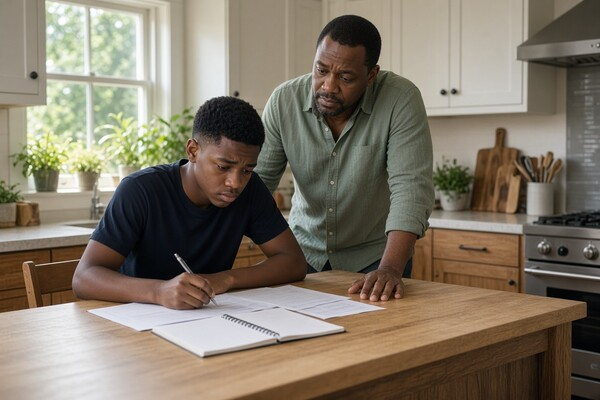
Concussion tracks with measurably lower academic performance, and the effect gets larger with each additional injury.
CDC analyzed 2017 Youth Risk Behavior Survey responses from 14,765 US high school students. In that sample, 15.1% reported at least one sports or play-associated concussion in the previous 12 months, and 6.0% reported 2 or more. Among athletes the figure was 21.4%.
The academic findings from the same analysis:
| Concussions in Past 12 Months | Self-Reported GPA | Reporting Mostly A's |
|---|---|---|
| None | 3.14 | 41.1% |
| One | 3.04 | — |
| Two or More | 2.81 | — |
| Any Concussion | — | 30.7% |
The regression coefficient was -0.22 for any concussion and -0.32 for multiple concussions. Students with a concussion were also more likely to report symptoms of cognitive impairment, with adjusted prevalence ratios of 1.37 to 1.49 across subgroups, rising to 1.85 for males with 2 or more.
Read that carefully before you act on it. This is cross-sectional self-report, so it establishes association and not cause, and students who play contact sports differ from those who do not in ways the survey cannot fully adjust for. What it does establish is that the academic effect is real enough to appear in a national sample of nearly 15,000 students, and that it scales with repeat injury.
What Changed in the Guidance, and Why Old Advice Is Still Circulating
The advice most parents have heard is out of date. The 6th International Consensus Statement on Concussion in Sport, from the Amsterdam conference and published in 2023, changed 3 things that matter here.
Complete rest is out. The recommendation is relative rest for the first 24 to 48 hours, with reduced screen time, followed by a return to light activity as tolerated. The older "cocoon therapy" approach of dark rooms and total cognitive rest is no longer supported and can extend recovery.
Sub-threshold aerobic exercise now starts early, typically between days 2 and 10, guided by heart rate thresholds, with symptom increases of no more than 2 points on a 10-point scale for under an hour treated as acceptable.
Persisting symptoms got one definition. Symptoms lasting more than 4 weeks, for all ages. The previous split of 2 weeks for adults and 4 weeks for children is gone.
CDC's clinical guidance sits alongside this: most students need only informal academic adjustments, and formal supports through a Response to Intervention protocol, a 504 plan or an IEP are for prolonged cases. CDC also advises specialist referral when symptoms persist beyond 2 to 4 weeks, and restriction of driving while attention, processing speed or reaction time are impaired.
The practical translation for a family: back to school early, at reduced load, with adjustments, beats waiting at home until everything feels normal.

What Helps, in Order
Run these in sequence. The order matters more than any individual item.
Get medical clearance and a written return-to-learn plan. Not a verbal one. The plan should name the accommodations, the review date, and who at the school is responsible. Ask for it at the clearance appointment, before anyone assumes recovery is finished. The same planning applies to any student returning to school after time away.
Cut the load before adjusting anything else. Fewer open assignments, fewer subject switches, shorter blocks. Reducing demand works immediately and requires no approval process.
Match each accommodation to a named deficit. Use the demand map above. An accommodation chosen from a generic list is a coin flip.
Externalise everything that used to live in working memory. One written place for every deadline, one visible daily plan, one checklist per recurring task. During recovery this is not a study skill, it is a substitute for a function that is temporarily offline.
Protect the afternoon. Executive function degrades with fatigue, and fatigue after a concussion arrives earlier than it used to. Schedule the hardest cognitive work first. Treat 3pm homework as the lowest-value hour of the day.
Re-measure at 4 weeks. Symptom resolution is not the finish line. Ask a different question: can the student plan, start, hold and check work at their normal academic load? If not, the executive rebuilding is unfinished even if the medical piece is closed.
Escalate to formal supports if it is still hard at 4 weeks. That is CDC's own referral threshold and the Amsterdam definition of persisting symptoms. A 504 plan exists for exactly this. Knowing what school support is available before you need it saves weeks.
On accommodations specifically, the delay is usually on the family's side rather than the school's. A nationwide survey of 87 college accessibility staff across 31 states, published in Frontiers in Neurology on 5 August 2026, found 70% could put a concussion accommodation in place in under 3 days and 89% within 4 days. The largest single barrier they reported was students not disclosing the injury, at 28%. Ask early. The system moves faster than most families expect.

What Does Not Work
Waiting until the student feels completely normal. This was standard advice a decade ago and the consensus moved away from it. Extended total rest can prolong recovery.
Brain-training apps as the main plan. A Frontiers in Psychology systematic review of 43 studies across 7 commercial devices, including Lumosity and Cogmed, found good evidence that these programs improve performance on tasks resembling the training itself, and little direct evidence of transfer to real-world performance. The authors were careful to say this reflects a shortage of rigorous studies rather than proven absence of effect. Either way, an app is not a return-to-learn plan.
Generic extended time as a default. It helps a student who needs to re-read. It hurts a student whose limit is fatigue, because it extends time on task. Pick it deliberately.
Treating the deficit as a behavior problem. The most common misread in this whole category. A student who cannot start work looks identical to a student who will not, and the correction that fits the second one makes the first one worse.
Comparing to the last concussion. Recovery trajectories differ between injuries in the same person. A student who bounced back in 8 days last time can take 6 weeks this time, and that is not evidence of anything except that this injury is different.

When Executive Function Coaching Fits, and When It Does Not
Executive function coaching is a fit once a student is medically cleared and the remaining barrier is rebuilding the skills school runs on. It is not a fit as a substitute for medical care.
What coaching does not do: it does not diagnose, treat or manage a concussion. It does not replace neuropsychological assessment, cognitive rehabilitation delivered by a licensed clinician, or speech-language therapy. If symptoms are active, worsening, or persisting past 4 weeks, the next call is to a physician, not a coach. Coaching also differs from therapy, which addresses the emotional side of a difficult recovery and is often the more appropriate first step.
What coaching does: it rebuilds the systems a student uses to plan, start, track and check their work, and it supplies the external structure while the internal version is still coming back. The Ladder Method has been providing executive function and study skills coaching for over a decade, working with students from elementary through college and with adults. Coaches come from backgrounds in education, psychology and learning science, and many hold master's degrees or teaching credentials.
The work targets 6 skills directly: organization through visual planners and workspace systems, time management through time-blocking and realistic scheduling, task initiation through micro-goals and structured accountability, working memory through note-taking and recall frameworks, emotional regulation, and cognitive flexibility. Sessions run weekly or biweekly and apply those to the actual work in front of the student. Students graduate when they run the systems without a coach.
For a student returning to a full academic load, the sequencing usually matters more than the tactics: rebuild working memory supports first, then task initiation, then long-range planning. Trying to fix planning while working memory is still unreliable does not hold.
Book a consultation if your student is medically cleared and school is still not working. Bring the return-to-learn plan and the last report card.
Frequently Asked Questions
How long does executive function take to recover after a concussion?
Longer than the physical symptoms. Most concussion symptoms resolve within 4 weeks, and the 2023 international consensus defines persisting symptoms as those lasting beyond that point. Executive function follows a slower curve. A 2023 meta-analysis of 8,877 adolescents found executive function still impaired at a moderate effect size (d = -0.56) between 1 and 6 months post-injury, at a point when processing speed and verbal memory had normalized. Individual recovery varies and a physician should be the one tracking it.
Can a concussion cause ADHD?
No. ADHD is a neurodevelopmental condition with an onset in childhood, and a head injury does not cause it. What a concussion can do is produce executive function difficulties that look very similar from the outside: trouble starting tasks, losing track mid-task, missing deadlines, careless errors. The distinguishing feature is timing. ADHD symptoms are present well before the injury. Post-concussion executive difficulty starts after it. A student with existing ADHD who sustains a concussion can experience a real worsening, and that needs a clinician rather than an assumption.
My child was cleared to return to sport but is still struggling in school. Is that normal?
Yes, and it is common enough to have a mechanism behind it. Return-to-play clearance is based on symptom resolution and a neurocognitive battery that reports verbal memory, visual memory, visual motor speed, reaction time and impulse control. It does not report executive function. School is close to a pure executive function task. A student can pass everything on the clearance protocol and still be unable to plan an essay. Tell the treating physician what you are seeing, because the academic picture is information they need.
What accommodations help most after a concussion?
The ones matched to the specific deficit. As a starting set: reduced assignment load, printed notes or slides in advance, one instruction at a time in writing, scheduled breaks, testing earlier in the day, extra time between classes, and interim checkpoints on long projects set by an adult. CDC's guidance is that most students need only informal academic adjustments, with a Response to Intervention protocol, 504 plan or IEP reserved for prolonged cases.
Should my child stay home from school until they feel better?
Current guidance says no beyond the first day or 2. The 2023 Amsterdam consensus recommends relative rest for the first 24 to 48 hours, with reduced screen time, then a graded return to activity as tolerated. Extended complete rest is no longer recommended and can lengthen recovery. The usual approach is an early return at reduced load with accommodations in place rather than a delayed return at full load.
Do brain-training apps help executive function after a head injury?
The evidence supports improvement on tasks that resemble the training and does not clearly support transfer to schoolwork. A systematic review of 43 studies across 7 commercial cognitive training devices found good evidence for near transfer and little direct evidence for far transfer to real-world performance, while noting that the research base itself is thin. Apps can be a component of a plan built by a clinician. They are not a plan.
Does a second concussion make executive function worse?
The data points that way. In CDC's analysis of 14,765 high school students, self-reported GPA fell from 3.14 with no concussion to 3.04 with one and 2.81 with 2 or more, and the association with cognitive impairment symptoms was strongest in students reporting multiple injuries. That analysis is cross-sectional and self-reported, so it shows association rather than cause. Decisions about return to contact sport after repeat injury belong with a physician.
When should we see a specialist?
CDC advises referral to a specialist when symptoms persist beyond 2 to 4 weeks. Use the same threshold for the academic picture. If a student is still unable to plan, start and check work at a normal load 4 weeks after injury, that is worth raising with the treating clinician rather than waiting to see whether the next term is better.