Executive Dysfunction Working From Home: Why It's Harder And What Helps
Executive dysfunction working from home feels worse because the office was running part of your executive function for you. The commute told your brain that work had started. Coworkers noticed when you drifted. Walking out the door ended the day. At home, you supply every one of those cues yourself, and supplying cues is the exact job executive dysfunction makes hard.
You're far from alone. Gallup's latest numbers put 52% of US employees with remote-capable jobs on a hybrid schedule and 26% fully remote. The CDC estimates that 15.5 million US adults, about 6.0%, have a current ADHD diagnosis, and 55.9% of them were diagnosed at 18 or older. A diagnosis that late means years of struggling without a name for it.
The fix is to rebuild those cues on purpose, one at a time.

Why Does Remote Work Put So Much Weight on Executive Function?
Remote work moves the structure of your day from the building into your head, where executive function has to handle it.
Executive dysfunction working from home is when the mental skills that run a workday break down once the office's built-in cues disappear. Those skills include starting tasks, holding focus, tracking time and stopping on schedule. It shows up as late starts, lost afternoons and evenings that never end. It's common with ADHD, but anyone can hit it.
Psychologist Adele Diamond's widely cited 2013 review names 3 core executive functions. Inhibition is holding back, working memory is keeping information in mind, and cognitive flexibility is switching plans. All 3 work better with outside prompts, and offices are full of them.
Before the pandemic, the average US commute added up to 55 minutes a day, according to a 2023 study by economists Cevat Giray Aksoy, Nick Bloom and colleagues. Remote workers put about 42% of that saved time back into their jobs. The ride did a job nobody noticed. It told your brain when work started and when the day was over.
Hybrid adds a twist. If you're home Monday, Wednesday and Friday, 3 mornings a week have no commute and no hello, and 2 bring both back. Your brain has to find the start of the day again each morning.

The 4 Places Executive Dysfunction Shows Up at Home
Executive dysfunction working from home tends to break in 4 spots: focus, time, starting and stopping. Most people have 1 or 2 that do most of the damage.
Why Is Focus Harder at Home Than at the Office?
At home, nothing pushes back when your attention drifts. Nobody walks past your desk, and the laundry, the fridge and your phone all belong to you.
The usual line is that home has more distractions. Let me correct that, because it points you at the wrong fix. Home has different distractions and fewer brakes. The pings come with you. Microsoft's June 2025 Work Trend Index found employees get interrupted by a meeting, email or chat every 2 minutes during core hours, about 90 times in a 3-hour morning.
UC Irvine researcher Gloria Mark has spent nearly 2 decades logging how long people stay on a single screen before switching. In 2003 it was about 2.5 minutes. In recent years it's averaged 47 seconds. At the office, a coworker glancing over puts a small brake on that drift. At home, the only brake is you.
No Commute, No Clock
Without a commute, the workday has no edges, and time blindness fills the gap.
Time blindness is trouble sensing how much time has passed or how long a task will take, and it's common with ADHD. An office shows you the time all day as people arrive, leave for lunch and pack up at 5:30. At home, 9:00 turns into 11:40 with no warning.
Keep the clock outside your head. An analog clock in your eyeline helps. So does a calendar block with an alarm 10 minutes before it ends.
Why Can't I Start Work When Nobody's Watching?
Starting a task takes a trigger, and an office hands out triggers all day. A standup meeting, a manager stopping by, even the sound of typing all push you toward the first action. Remove them and task initiation becomes a solo job.
Say it's Tuesday. You open the laptop at 8:55 planning to write a client report. You check email first, because email feels like work. Then the team chat. At 10:15 the report is still a blank page, and the day already feels behind.
Nothing in that morning was laziness. The first step was too big, and nothing outside you made it smaller.
When the Laptop Never Closes
When work and home share a room, work leaks into the evening unless something stops it.
Microsoft's data shows 29% of active workers are back in their inboxes by 10 p.m. With executive dysfunction, the evening check-in rarely stays small. A single email turns into an hour of catching up on whatever slipped. Then the next morning starts tired, the first step feels bigger, and the loop runs again. Left running long enough, that loop can end in ADHD burnout.
Is the Office Better for Your Brain?
Not by default. The office gives you cues, and it also hands you a steady stream of interruptions.
Most advice treats the office as the place where focus comes easy. I don't buy it. When Harvard researchers Ethan Bernstein and Stephen Turban tracked 2 companies that moved staff into open-plan space, face-to-face interaction dropped about 70% and email went up.
You've probably seen the claim that it takes 23 minutes to refocus after an interruption. That figure comes from a 2006 interview with Gloria Mark. Her peer-reviewed 2005 study, which observed 24 office workers, found interrupted work resumed after about 25 minutes, usually with 2 other tasks in between. Both numbers came from offices.
The strongest test ran at a large travel company in Shanghai, where Nick Bloom, Ruobing Han and James Liang split 1,612 employees by birthday. One group worked in the office 5 days a week and the other worked from home 2 days a week. The hybrid group quit 33% less often, and their performance held steady, in results published in Nature in June 2024.
The office wins on cues, and home wins on control, so the job is to carry the cues home. These 4 matter most.
Start signal. The office has a commute and a first hello. At home there's nothing until you build it.
Interruptions. Offices bring people and pings. Home keeps the pings and adds chores and your phone.
Stop signal. Leaving the building ends an office day. A home workday ends when you decide it does.
Someone who notices. Coworkers see you drift and see you finish. At home nobody sees either.
7 Fixes for Executive Dysfunction Working From Home
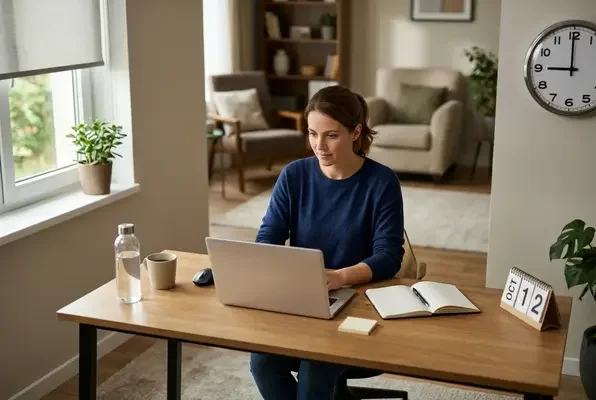
Each fix below rebuilds 1 cue the office used to supply. Start with the one that matches your worst spot, rather than trying all 7 in the same week.
Every Workday Needs a Start Cue and a Stop Cue
Pick 1 physical action that starts your workday and 1 that ends it, and do both at the same time every day.
A start cue can be tiny. Fill a water bottle and open 1 specific file. A stop cue runs in reverse. Write tomorrow's first step on a sticky note and shut the laptop.
A fixed cue turns a vague intention into an if-then plan, like "At 9, in this chair, I open the report." Peter Gollwitzer and Paschal Sheeran's 2006 review of 94 studies found if-then plans had a medium-to-large effect on reaching goals. Most articles quote that number. I'd quote the newer one. In 2025, Sheeran, Gollwitzer and a colleague pooled 642 tests and found an effect on behavior less than half that size. Smaller, but real, and it costs a sticky note.
Give Work Its Own Spot, Even a Small One
A dedicated spot helps because it becomes a cue, and the habit of working only there matters more than the furniture.
A spare room is great if you have one. If you don't, a single chair that only ever means work does most of the same job. A kitchen table works too if 1 object turns it into an office, like a lamp that's on only during work hours.
Noise is the other half, which is why the Job Accommodation Network lists noise cancellation and a quiet workspace among its ADHD accommodations.
2 Apps Are Enough to Start
The right tool takes a decision off your plate. Start with a timer and a site blocker, and add a third app only after both are habits. The blocker does the inhibition job a passing coworker used to do.
The Pomodoro method, 25 minutes of work and a 5-minute break, is the timer setup everyone recommends. Its evidence is thinner than its fame. Since 2023, 3 trials with university students have compared fixed breaks with breaks people chose. The first found fixed breaks left students less tired and distracted. None found fixed breaks got more work done, and none tested remote workers or adults with ADHD.
Short breaks help in a different way. A 2022 PLOS ONE review of 22 study samples and 2,335 people found breaks of 10 minutes or less raised energy and cut fatigue a little. Performance didn't reliably improve.
My advice is to use the timer to start work and to end breaks, because the break is where the next hour tends to vanish.
Shrink the First Step Until It Feels Silly
"Write the Q3 report" is a project. "Open the Q3 file and type the title" is a first step. Make the first step small enough that starting costs almost nothing.
That's the micro-goal approach The Ladder Method's coaches use for task initiation, paired with structured accountability so the step happens. The tiny step does 2 jobs. It gets you past the start, and it gives you proof by 9:05 that the day has begun.
If even the silly step won't happen, look past it. The usual culprits are dread or a missing piece of information. Make finding that piece the first step.
Put a Hard Edge on the Workday
Decide your stop time in the morning and make it visible, because a workday with no end drains the next one.
Researchers call the goal psychological detachment, meaning you mentally leave work behind after hours. A 2017 review of 91 study samples covering 38,124 employees tied more detachment to less exhaustion and better sleep. After-hours use of work devices went with less of it.
A 4-step shutdown routine makes the edge physical.
Write tomorrow's first step where you'll see it at 9.
Close a work-only browser profile, so every work tab disappears at once.
Turn off work notifications on your phone at the same hour every day.
The laptop goes somewhere you can't see from the couch.
The point is to make the evening check-in take effort. Effort is what executive dysfunction avoids, so let it work for you.
Does Body Doubling Work Over Video?
Often, yes, though most of the evidence so far is self-reported.
Body doubling means working alongside another person, in the room or on camera, so their presence keeps you on task. Researchers at UC Santa Cruz surveyed 220 adults, 139 of them with ADHD. Of the 220, 75% used body doubling, and 81 did it online through video calls or streams. Nearly half, 49%, said they were more likely to finish a task with someone else present.
Not everyone buys it. Will Canu, a psychologist at Appalachian State University, told Popular Science that the evidence so far is anecdotal. No large randomized trial has tested it. Treat it as a 2-week experiment and count what you finish. I'd use it for starting and for admin. For deep writing, a watcher can become one more thing to manage.
It also helps with isolation. In Gallup's latest global data, 24% of fully remote employees felt lonely for much of the previous day, against 18% of on-site staff in remote-capable jobs.
Sleep and Movement Come Before Any System
If you're short on sleep, no app will rescue your focus. Fix sleep first, then add movement.
A recent CDC report found 30.5% of US adults get less than 7 hours of sleep a day on average, short of the 7 or more that sleep specialists recommend. Short sleep drags down attention and working memory, 2 skills remote work leans on hardest.
Movement costs even less. A 2025 review in Psychological Bulletin pooled 383 studies with 18,347 people and found a single bout of exercise improved executive function by a small-to-moderate amount. Exercise type, intensity and length didn't change that, so a 10-minute walk before your start cue counts.

When Should a Remote Worker Get Executive Function Coaching?
Get outside help when 2 or 3 of these fixes keep falling apart after a month, or when the slipping shows up in reviews and missed deadlines.
That's the work The Ladder Method has done since Candice Lapin founded it in Los Angeles in 2008. About 70% of its clients have ADHD, autism or other executive function challenges. Coaches come from education, psychology and learning science, and each trains in the company's framework first. Sessions run weekly or every other week, in person in Los Angeles, New York, Chicago, Dallas and Austin, and online everywhere else.
The coaching programs for adults cover time management, planning and organization, the skills an office used to prop up. Coaches use time-blocking, micro-goals and structured accountability. The company says most clients notice a change within 4 to 8 weeks. It's the same reason a business hands a slipping project to an outside partner. Someone outside you holds the date.
Be clear-eyed about the research. A 2018 review found 19 studies of ADHD coaching, all reporting gains in symptoms or executive function, but 15 of the 19 had no control group. The evidence is encouraging and thin, and any coach who claims more is overselling.
Coaching isn't the only option. If you have ADHD or another qualifying condition, you can ask your employer for accommodations. The EEOC says working from home can be a reasonable accommodation under the ADA, though employers can choose among options that work.
This article leaves out medication and diagnosis on purpose, because both belong with a clinician. It also skips advice for managers of remote teams, a different problem with different fixes.
If 2 or more of the 4 spots sound like your week, book a consultation and bring your worst recent workday. A single bad day, walked through in detail, usually shows which cue is missing.
Executive dysfunction working from home is a cue problem before it's anything else. Rebuild the start and end of your day first, then add someone who notices.
Frequently Asked Questions
Is executive dysfunction working from home a sign of ADHD?
Sometimes. ADHD is a common cause, but depression, anxiety, short sleep and burnout can produce the same pattern. In the CDC's 2024 report, 55.9% of US adults with ADHD were diagnosed at 18 or older, so finding out late is normal. If the pattern started long before remote work, ask a clinician for an assessment.
Is remote work better or worse for people with ADHD?
It depends on which cues you rebuild. A 2024 review of 25 studies in Occupational Medicine found neurodivergent employees gained flexibility at home but lost routine. In a Japanese survey of 1,804 workers, hybrid workers with ADHD symptoms had lower depression scores than fully on-site ones, with no difference in productivity.
Why can I focus at the office but not at home?
The office supplies cues you never had to create, like a set start time, people who notice when you drift and a building you leave at night. At home none of those exist by default, so your executive function has to produce them. Rebuild them 1 at a time, starting with a fixed start ritual.
Does body doubling work on a video call?
Often, going by what people report. In a UC Santa Cruz survey of 220 adults, 75% used body doubling, 81 did it online, and 49% said they're more likely to finish a task with someone present. No large randomized trial has tested it yet, so run it for 2 weeks and count what you finish.
Can I get accommodations for executive dysfunction when I work remotely?
You can ask, if you have a qualifying condition such as ADHD. The EEOC says working from home can be a reasonable accommodation under the ADA, and the Job Accommodation Network lists timers, written to-do lists and job coaching for ADHD. In JAN's survey of employers, 61% of accommodations cost nothing.
How long does it take to fix executive dysfunction working from home?
Plan on weeks. The Ladder Method says most clients notice a change within 4 to 8 weeks of weekly or biweekly coaching. On your own, give each new cue 2 weeks before you judge it, and add 1 at a time so you can tell which one worked.