The first signs of ADHD in marriage are small and boring, like a dentist appointment nobody booked or an electric bill paid after its due date. Each miss is minor. Stack up enough of them and the marriage changes shape.
The spouse without ADHD starts tracking everything, and the spouse with ADHD starts getting reminded about everything. Give it long enough and you're living as manager and managed, and both of you resent it. That's the usual path ADHD takes through a marriage. Missed tasks and slipping deadlines push couples into roles neither person chose, and the roles do more damage than the tasks ever did.
You can change the most with the least drama, because the friction comes from skills you can build and from memory jobs you can move out of your head. Getting diagnosed years into a marriage is common, too. More than half of US adults with a current ADHD diagnosis, 55.9%, received it at 18 or older, according to a late-2023 CDC survey.
The Short Answer
ADHD in marriage is the strain that builds when a spouse's ADHD affects memory, time, planning and emotional control at home. It usually settles into a parent-child dynamic, where the spouse without ADHD manages and the other spouse gets managed. The fix is skill-building for the spouse with ADHD plus shared systems both spouses own.
Memory, time, planning and emotional control are all executive functions, the mental skills that turn an intention into a finished task. ADHD weakens them. Love isn't on that list, and couples who read every slip as a love problem spend years fighting about the wrong thing.
This guide sticks to the everyday mechanics of ADHD in marriage and won't cover affairs, addiction or abuse, which need a licensed clinician. If anyone at home feels unsafe, contact emergency services or a domestic violence hotline before anything else.
Everything below assumes 2 adults who still like each other on a good day and are tired of having the same 5 fights.
Why Do Couples Slide Into Parent and Child Roles?
Couples slide into parent and child roles through a sensible trade made again and again. Whoever remembers takes over the remembering.
On a normal Tuesday, the car registration turns out to have expired last week, so the spouse without ADHD renews it on a lunch break. They add the kids' eye exams to their own calendar and text a reminder about school pickup. Each move is reasonable. Nobody discussed any of them, and over time those handoffs add up to a job title.
Melissa Orlov, author of The ADHD Effect on Marriage, calls the result the parent-child dynamic. The managing spouse feels like a parent with an extra kid. The managed spouse feels watched and behind, with a steady low hum of shame.
Both spouses lose, and a 2022 study put numbers on it. Researchers in Ankara, Turkey, compared 56 married couples, half of them with a spouse diagnosed with ADHD. The spouses with ADHD scored 37.5 on a standard marital adjustment scale, and the comparison group averaged 48.6. Their partners without ADHD scored low too, 40.4 against 49.8. The managing spouse isn't coming out ahead.
The pattern reaches the bedroom as well. An ADDitude survey of 1,256 partners found 51% of those without ADHD said ADHD put a damper on intimacy. Among respondents with ADHD, 42% rated the effect of their symptoms on their sex life as "a lot." Attraction doesn't survive much supervision.
The roles formed around jobs like remembering, scheduling and paying, which means they come apart the same way, 1 job at a time.

What ADHD Changes Inside a Marriage
ADHD changes the machinery between meaning to do something and getting it done. How much either of you cares stays the same.
You'll often see ADHD in marriage described as a communication problem. That framing is close, and it still sends couples to the wrong fix. Communication is where the trouble surfaces. The trouble starts earlier, in memory, time and emotional control.
The Ankara study measured conflict too. The spouses with ADHD scored 53.2 on conflict frequency, nearly 3 times the comparison group's 19.3.
Psychologist Russell Barkley has a rule of thumb for this. He estimates that executive function in ADHD runs about 30% behind a person's age, so a 40-year-old may plan and follow through more like a 28-year-old. The estimate helps explain how a spouse can run a team at work and miss a parent-teacher conference at home, and it fits what's known about how these skills develop with age.
Where Does the Forgotten Task Go?
Usually nowhere you can get it back. Working memory holds a task in the minutes between hearing it and doing it, and ADHD weakens that hold.
Your spouse asks you to call the plumber while you're halfway through an email. The request lands, the next sentence of the email writes over it, and it's gone without a trace. By dinner, your spouse remembers asking and you don't remember hearing. Both of you are telling the truth.
Time slips the same way. With time blindness, anything not due today registers as later, so the anniversary dinner gets booked that afternoon, if it gets booked at all.
Why Does a Small Reminder Turn Into a Big Fight?
Your reaction to a reminder runs on emotional regulation, another executive function, and it fires before you've chosen a reply.
A 2025 study in the Journal of Social and Personal Relationships surveyed 286 adults with ADHD in romantic relationships. Emotional dysregulation was a strong predictor of feeling hurt by a partner.
So "did you call the plumber?" gets heard as "you always forget." The answer comes back sharp, and the rest of the evening is about tone. The plumber still hasn't been called.
Snapping is still yours to own. The mechanism tells you where to practice, in the moment between hearing a reminder and answering it.
5 Terms That Explain ADHD in Marriage
Couples handle ADHD in marriage better when they share a vocabulary. These are the 5 terms worth agreeing on.
The parent-child dynamic is the pattern where the spouse without ADHD manages the household and the spouse with ADHD gets managed, leaving one resentful and the other ashamed.
Mental load is the background job of holding a household's dates, supplies and deadlines in mind, like the dog's vet visit and the school form due Friday.
Barkley's 30% rule estimates that executive function in ADHD runs about 30% behind a person's age.
Time blindness makes it hard to sense time passing and deadlines approaching, so tasks feel urgent only at the last minute.
Externalizing means moving reminders, plans and deadlines out of a person's head into tools both spouses can see.

Does Forgetting Mean Your Spouse Doesn't Care?
No. A forgotten errand in an ADHD marriage measures working memory, and it tells you next to nothing about love.
The Ankara couples study points the same way. Among the spouses with ADHD, inattention scores tracked conflict frequency closely (r = 0.60). Hyperactivity scores showed no meaningful link. In a sample of 28 couples that's a strong hint rather than proof. The pattern suggests the fights follow the forgetting more than the restlessness.
Forgetting still lands like a verdict because most people treat memory as proof of priority. If it mattered, you'd have remembered. That rule works for most brains and fails for yours, and your spouse can't see the difference from the outside.
Your side of the exchange can make it worse. Some clinicians use the term rejection sensitive dysphoria for the outsized sting of perceived criticism in ADHD. It isn't a formal diagnosis and the DSM-5 doesn't list it, but the pattern is easy to spot at home. A sigh gets heard as "you're hopeless," you get defensive, your spouse feels brushed off, and the reminder that started it never gets fixed.
A memory problem needs a memory fix. That means systems outside your head, and trying harder doesn't count as one.
How Do You Stop Having the Same Fight Every Week?
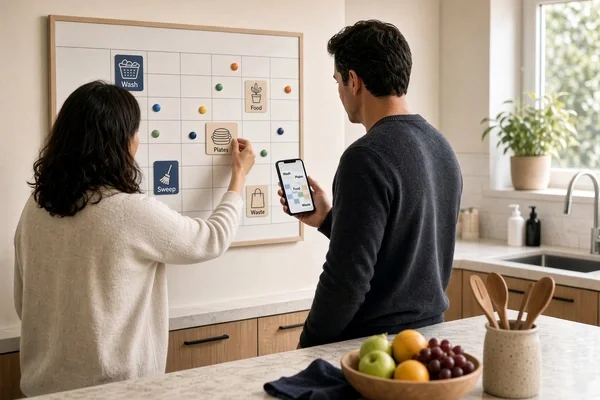
Stop asking memory to do the job. Move each recurring task into a system both spouses can see, and give it a named owner.
A warning. When the spouse without ADHD designs the system, runs it and checks it, you've built a tidier version of the parent role. Build it together, and give the spouse with ADHD full ownership of specific jobs, reminders included. Contained jobs with a clear tool make the best first handoff. For parents of a child preparing for the ISEE or ERB, running the nightly practice with a set of ISEE vocabulary flashcards fits, because the test date sets the finish line.
These 5 repeat fights each have a system that ends them.
Trash night becomes a repeating phone alarm the evening before pickup, owned by the spouse with ADHD and labeled with which bins go out.
Every appointment gets entered in the shared calendar by whoever books it, before the call ends.
Fixed bills go on autopay from 1 joint account, and variable bills get an alert ahead of each due date.
Dinner runs off a short list of default meals you both like, rotated, so nobody plans from scratch after work.
The "I carry everything" fight gets a short Sunday check-in where each of you names what the other needs to know about the week.
Put Every Commitment on 1 Shared Calendar
Choose 1 calendar you both use, and agree that a plan only exists once it's on there. That rule ends a whole category of "you never told me."
I'd pick a digital calendar over a paper one for most couples, because an alert follows you to work and a wall calendar can't. The exception is a spouse who ignores their phone. For that person, a big calendar by the front door wins.
Set 2 alerts for anything that matters, one the day before and another on the day itself.
Keep Every Open Task Where You Both Can See It
A task that lives in 1 person's head is invisible to the other person and unreliable for the person holding it. Put open tasks on a list you both see every day. A shared notes app works, and so does a whiteboard by the coffee maker, which has the advantage of being impossible to close.
Write the task down while the conversation is still happening. Agreements that wait until later turn into memory jobs again.
Decide Once and Automate the Rest
Automation keeps working on the weeks when nobody's at their best. Set prescriptions and contact lenses to auto-refill. Keep a saved grocery cart you re-send on Sundays. Enter every birthday once, with an alert early enough for the gift to ship on time.
Support has to work in both directions, too. The same 2025 study found adults with ADHD who felt more supported by their partners reported higher relationship satisfaction at every symptom level. So tell your spouse which help works for you, like a calendar invite, and which doesn't, like a reminder in front of the kids.

When Systems Aren't Enough: Therapy, Coaching and the Evidence
If the systems are running and the marriage still hurts, the problem has moved past logistics, and it's time for outside help. Watch for 4 signs. Contempt has become the normal tone. Depression or anxiety is going untreated. Fights start over nothing practical at all. One of you has stopped wanting to try.
Couples therapy is the default suggestion for ADHD in marriage. A February 2026 systematic review in Medical Research Archives found only 3 intervention studies testing couples-based treatment for adult ADHD. One of the 3, a randomized trial of Sweden's PEGASUS program, enrolled 179 adults with ADHD and the people closest to them across 5 Stockholm clinics. PEGASUS raised ADHD knowledge by a wide margin (d = 0.97). Relationship-quality scores didn't improve, though the partners and relatives criticized less afterward.
Couples therapy can still help with resentment, grief and contempt, and those are real problems. On the evidence so far, it isn't an ADHD treatment.
Executive function coaching works on a different layer, the skills that keep the systems running. The Ladder Method's adult executive function coaching covers task initiation, working memory, emotional regulation and cognitive flexibility, plus productivity systems, deadline management and organizational habits.
Over the past decade, The Ladder Method has supported hundreds of adults across the United States, in person in Los Angeles and virtually. The company says about 70% of its clients are neurodivergent, especially people with ADHD or autism spectrum differences. Coaches train in the Ladder Method framework, and sessions run weekly or biweekly until the client shows consistent independence.
Your First Week: 4 Moves to Make
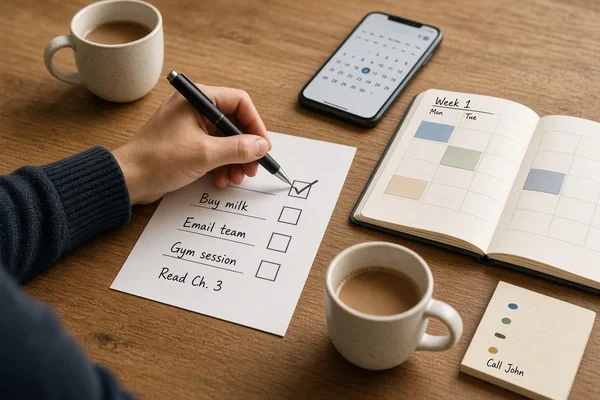
Give yourself 1 week and 1 fight.
Choose the argument you've had most this month and build its fix together, using an alarm, an autopay rule or a shared list.
Take over 1 household job completely, remembering included, and tell your spouse they're off duty for it. With a high schooler at home, the college list is a good candidate, and The Ladder Method's College Kickstarter course covers how to build one before SAT and ACT prep starts.
Hold your first Sunday check-in with both calendars open.
If the friction is mostly about skills, book a consultation for coaching. If it's mostly about hurt, find a licensed couples therapist. Some couples need both.
Most of what hurts about ADHD in marriage gets easier once memory stops being the thing you fight about. Move the remembering into systems, own your share of them, and see what's left to talk about.
Frequently Asked Questions
What Does the 30% Rule Mean for ADHD in Marriage?
The 30% rule is psychologist Russell Barkley's estimate that executive function in ADHD runs about 30% behind a person's age. By that math, a 40-year-old spouse may plan and follow through more like a 28-year-old. Barkley offers it as a rule of thumb, and no single study measured the 30% figure.
Why Does Marriage to an ADHD Spouse Feel Like Parenting?
Because every time a task slipped, you caught it, and catching turned into your job. That role grows out of a long run of small rescues rather than a single decision. The feeling eases when your spouse takes over specific jobs completely, reminders included, and you stop catching.
How Common Is Thinking About Divorce in an ADHD Marriage?
Common, at least among readers who answer surveys about it. Of 1,256 partners in an ADDitude survey, only 24% of spouses without ADHD said divorce had never crossed their mind, and 38% of the ADHD respondents reported a marriage that had come close to divorce. The sample was self-selected, so treat those numbers as a signal rather than a national rate. Thinking about leaving decides nothing, and it's a reason to get help sooner.
How Much Does ADHD in Marriage Raise Divorce Risk?
Enough to show up in long-term studies. A 33-year study in the Archives of General Psychiatry followed boys diagnosed with ADHD to an average age of 41 and found 31.1% had divorced at some point, against 11.8% of a comparison group. A 2008 study found parents of children with ADHD divorced more often by the child's 8th birthday, 22.7% compared with 12.6%. Both studies show an association, and neither shows that ADHD causes divorce.
Does ADHD Medication Help a Marriage?
Medication can ease the symptoms that start fights, and the decision belongs with a prescriber. A 2018 Lancet Psychiatry analysis of 51 adult trials found stimulants such as amphetamines and methylphenidate cut ADHD symptoms more than placebo over the short term. Medication won't divide chores or rebuild trust, though. In the Ankara study, 16 of the 28 spouses with ADHD were already taking it, and the group still scored nearly 3 times higher on conflict.
What Happens When Both Spouses Have ADHD?
A marriage with 2 ADHD spouses is more common than chance would predict. A Swedish registry study of 707,263 people with psychiatric diagnoses, published in JAMA Psychiatry in 2016, found people tend to pair with partners who share their diagnosis, and ADHD showed one of the stronger pulls. With 2 ADHD brains in the house, nobody is the default rememberer, so automation and outside accountability have to carry more of the load.